
12 March 2026
From benign neglect in the 1950s, Israel began actively to interfere in Palestinian education in the 1960s, limiting access to suitable textbooks for schools and scientific materials for colleges and universities, arresting students and teachers, erecting checkpoints, shutting down institutions for shorter or longer periods, and in Gaza deliberately destroying the whole educational infrastructure. As the report reprinted below from Electronic Intifada describes, Israel has persisted in and even intensified this scholasticide down to the present: a policy that Israel’s “allies” such as Britain, France, Germany, the US and Canada do precisely nothing to discourage.
Military raids target West Bank education
Bothaina Hamdan The Electronic Intifada 10 March 2026
Education in the West Bank is a daily struggle. Settler and military attacks occur constantly, putting lives at risk and disrupting normal routines.
More than 1,000 Palestinians in the West Bank have been killed since Israel’s genocide in Gaza started in October 2023.
Students and teachers are often unable to reach their educational establishments because of Israeli military checkpoints and closures around Palestinian villages and cities.
University life is particularly affected, not least because of Israeli raids on campuses and because students are of an age often targeted for detention and violence.
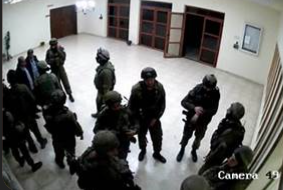
In one such raid at Birzeit University near Ramallah in early January, 11 students were hospitalized with injuries from live ammunition, tear gas inhalation and so-called rubber bullets.
In such an environment, parents live with constant anxiety for their children, while many students have been forced to arrange with universities to study online, appearing in person only for exams.
“I was in the center of Ramallah when I heard people talking about a military attack on Birzeit,” said Molouk al-Saadi, a government employee who lives in Ramallah some 15 minutes by car from Birzeit University.
“I checked my phone to find a flood of updates. Within seconds, without even thinking, I hurriedly called my daughter Lamar, who studies [at Birzeit]. I went crazy when I couldn’t reach her.”
Social media only added to her anxiety.
“I looked at the videos I received. They were horrifying: students fleeing from tear gas and live ammunition. I rushed to find transportation to the university, imagining the worst. Only later did my daughter call me to say she and her colleagues were safe and had left with her uncle, who lives nearby.”
Largest raid
Officials described the January raid as the largest military raid on a Palestinian university in the West Bank since October 2023, an “unprecedented assault,” according to Sadeq al-Khdour, spokesperson for the Palestinian ministry of education.
“While Palestinian education has long been a target for the occupation, this raid was the largest in scale,” he said. “It was carried out in full view of students and professors, aggressively with live ammunition.”
It also wasn’t an isolated incident. According to the UN, Birzeit University has beenrepeatedly targeted, the raid in January being the 26th since 2002.
Since October 2023, the Israeli military has killed 37 university students, injured some 260 across the West Bank and detained over 460.
According to the Ministry of Higher Education’s latest report, covering the period from 7 October 2023 to 30 December 2025, the Israeli occupation – both soldiers and settlers – has also killed 119 school students in the West Bank schools, injured more than 800 and arrested over 400.
The report documented repeated raids on educational institutions, attacks on staff and demolition orders against schools.
Al-Khdour also cited raids on universities such as the Palestine Polytechnic University in Hebron and Al-Quds Open University in Ramallah, in addition, of course, to the systematic and wholesale destruction of schools and universities during the ongoing genocide in Gaza.
Al-Khdour told The Electronic Intifada that the ministry formally lodged complaints with all diplomatic missions to Palestine, and sent official letters to UNESCO, UN and UNICEF, calling on them to honor their responsibilities and protect education in Palestine.
Military raids on educational establishments, he added, constitute violations of international humanitarian law, including the Geneva Conventions, and the Universal Declaration of Human Rights.
“It is not only a violation against Palestinian educational institutions, it violates all norms of educational protection, which the Israeli occupation no longer respects,” he said.
Daylight assault
Molouk’s daughter Lamar, a nursing student, had been in class during the raid, following updates on her phone, as terrified students tried to understand what was happening.
“I was in a lecture when military jeeps surrounded every building,” Lamar said. “Soldiers fired [tear] gas bombs immediately. Within the first half hour, dozens were injured and suffocating. I saw blood on the ground, we were trapped, no one could leave or enter, including ambulances.”
She had previously studied in Turkey in 2023, but after the earthquake in 2023 that killed over 55,000 people there and in Syria, her family decided she should continue her studies in Palestine.
“Safety is almost impossible to find,” her mother conceded. “Our children’s lives are at risk all the time, even when they are sitting in school and university.”
The January raid was in part unusual because it happened in broad daylight.
“Usually the occupying army attacks universities at nights, sometimes during the day, but when no students are there,” Ghassan Albarghouti, Birzeit University’s dean of students, told The Electronic Intifada.
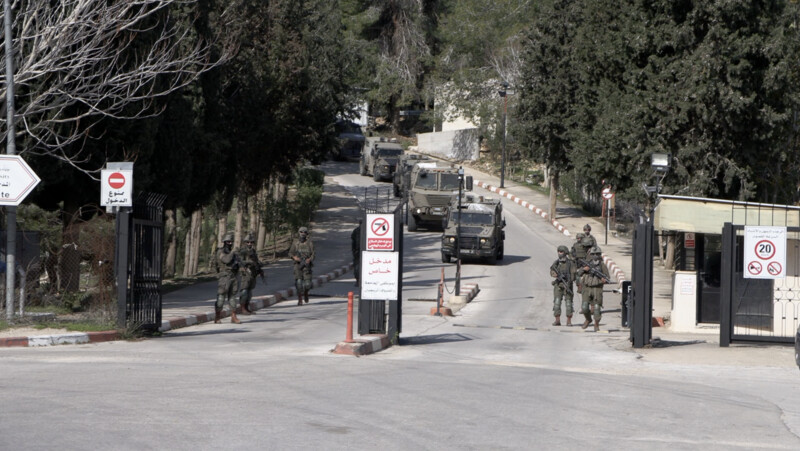
This time, however, a convoy of armored military jeeps entered the campus in the morning when, according to Albarghouti, over 10,000 students were present along with more than 1,500 faculty and staff.
“The army entered the main gate and spread quickly along the central road of the campus. They immediately fired stun grenades and tear gas canisters.”
Academic and administrative staff, he said, formed a human shield between the soldiers and students to avoid any losses or further escalation.
“But soldiers still used live ammunition, causing serious injuries, in addition to their aggressive movements.”
The Israeli military claimed students were throwing stones, according to both Lamar and Albarghouti, an accusation Albarghouti rejected.
“The campus streets are paved and clean, covered with only asphalt, even the gardens around are full of decorative plants. There were no stones, only shocked students chanting spontaneously and peacefully.”
Lamar remembers how one professor tried to protect students, urging them to hide in the buildings, when a soldier pointed his weapon at him, ordering him not to move.
“They threatened us not to organize any protest for our martyrs or prisoners,” she said.
Constant violations
Military attacks on educational establishments are clear violations of international law. The wholesale destruction of Gaza’s education sector constitutes a crime against humanity.
The Israeli military claimed the Birzeit raid was an attempt to prevent a “gathering in support of terrorism,” according to Israeli media, a claim rejected by students and faculty there.
The timing of the assault coincided with several student activities, Lamar told The Electronic Intifada, including a protest organized for a martyred student, Baraa Khairy Ali Maali, who had been killed in late November last year.
Albarghouti told The Electronic Intifada that other activities taking place included a student vigil in solidarity with Palestinian prisoners in Israeli detention, many held without charge or trial, and a screening of The Voice of Hind Rajab, the award-winning docudrama about the murder by Israeli troops of a six-year-old girl in Gaza in 2024.
He added that the Israeli military had cited the film screening as part of their justification for the assault, even though the film “has been screened widely both locally and internationally,” where, among other prizes and nominations, it won several awards at the 2025 Venice Film Festival, including the Grand Jury Prize.
At least forty students were injured in the shock, panic and chaos, Albarghouti said. Many were treated in the university clinic while 11 were sent to hospital.
“Two students remained hospitalized for two days,” Albarghouti said, “while another sustained a severe wound caused by an explosive dumdum bullet – resulting in bone fragmentation as well as pelvic damage – and needed several medical surgeries.”
In addition, Albarghouti said, Israeli soldiers confiscated sound equipment supposed to be used in the student activities, destroyed the electronic iron gate at the main entrance to the university and damaged several vehicles on campus.
In the days following the assault, many students were unable to attend their lectures, while debates continued on campus over whether to organize national activities or not. But student bodies have so far rejected a shift to e-learning, viewing it as a long-term objective of the occupation.
Meanwhile, threats and attacks against educational establishments in the occupied West Bank continue. In early February, Israeli settlers raided a school in the village of Ibziq in the northern West Bank, smashing doors, windows and classroom contents, along with solar panels and water tanks, while stealing solar batteries and water tanks.
“We will continue our education,” Lamar said. “We’ll keep following updates on our way to university, caring about our safety as much as we can. This is our adaptation under occupation.”
Bothaina Hamdan is a Palestinian writer in Ramallah and a refugee from Annaba village, destroyed in 1948, who writes on cultural memory and heritage under war.