




13 August 2026
Once again, a university has decided that criticising Israel’s appalling actions in Palestine is antisemitic and its student perpetrators must be punished. The irony here is that the university in question, Carnegie Mellon in Pittsburgh, has a “free speech fence” where for practically 100 years students have been permitted to express their views. Last year the University president forced the elimination of a call to keep President Trump off the campus days before a Presidential visit was scheduled, but subsequently agreed to abjure from interfering with statements on the fence. But this year he decided that criticism of Israel and Zionism “crossed the bounds of community norms” and must be suppressed. Michael Arria in Electronic Intifada describes this lamentable affair.
Power & Pushback: Carnegie Mellon investigating students over pro-Palestine messages
By Michael Arria August 11, 2026
FacebookXBlueskyWhatsAppRedditLinkedInMastodonEmailPrint
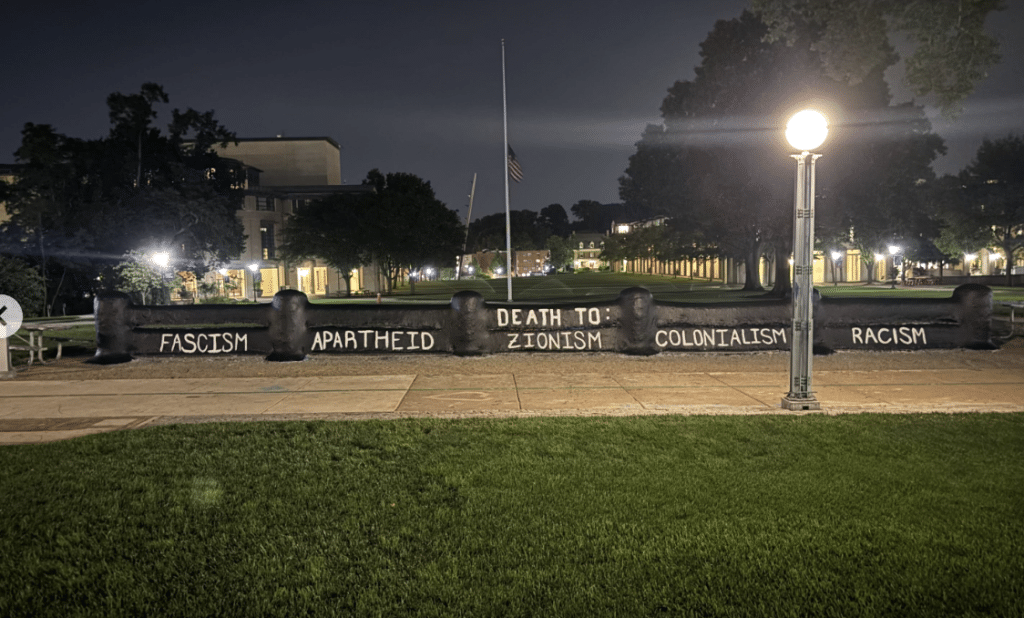
CMU Fence Instagram account
Carnegie Mellon University (CMU) has launched a civil rights investigation into ten activists for painting pro-Palestine messages on a campus “free speech fence.” Eight of the individuals are barred from campus during the Title VI probe.
Painting the fence is a longtime tradition at the university.
“The Fence is an iconic piece of Carnegie Mellon’s Pittsburgh campus,” explains the school’s website. “Serving as a student-centered space for free expression and community, The Fence has brought the CMU community together for more than 100 years.”
The website also cites various messages that have been portrayed on the sign, including “Black Lives Matter” during the protests of 2020.
On June 9, the Palestinian flag and the line “75 years of apartheid, 56 years of occupation, 16 years of blockade” were painted on the fence, along with the phrase. “Free Palestine by any means necessary.” The message was condemned by the university president Farnam Jahanian, who sent out an email saying the phrase was interpreted as a “call to violence” by some Jewish community members.
“Words have power. Freedom of expression carries with it a responsibility to consider the weight of our words and their impact on those around us,” wrote Jahanian. “We may choose to give the benefit of the doubt to the individuals involved in painting the Fence because we have faith in our shared humanity. However, if your intent is not to threaten or intimidate others, choose words that do not communicate a threat. If your intent is not to endorse violence, choose words that do not support that interpretation. The issue before us is not merely what the anonymous messengers intend to convey but whether the reasonable effect of their words would be to cause others to feel physically threatened.”
Later that month, Jewish students tagged the fence in Yiddish. “Forcing Ideological Conformity (Zionism) on Jews is Anti-semitic – FREE PALESTINE” was painted on one side of the fence. On the other side, “Here where we live, that is our country” (the General Jewish Labor Bund’s motto), along with “Death to Zionism.”
The message was painted over, the police were called in, and Jahanian sent another campus-wide email.
“Following conversations with concerned community members, Facilities Management Services worked in consultation with CMU Police to repaint the Fence. I am grateful for the individuals who made this decision onsite and who recognized that a call for ‘death’ violated our longstanding policy against such threats of violence, including threats based on an individual or a group’s affiliation or identity,” it explained. “Moving forward, we will continue to quickly remove threatening language wherever it appears on campus, fully investigate these incidents and intervene as necessary.”
The fence has been painted by pro-Palestine activists multiple times in July. In one case, the message read, “Multiple Choice: Which Will they Censor? Death to: fascism, apartheid, zionism, colonialism, racism.” Only the word “Zionism” was censored this time, and the president sent out another email.
Advertisment
“Let there be no ambiguity on the university’s position with respect to this issue: this is not a matter of freedom of expression or even about the rules of engagement at the Fence specifically; this is a community standards issue,” read this one. “Carnegie Mellon will not tolerate messages on university property — attributed or, in this case, anonymous — that incite or imply violence, which can reasonably be viewed as threatening to members of our community.”
Supporters of the activists say that Palestine is being unfairly targeted, as other political messages using similar language adopting similar language have been left uncensored. In fact, this summer, “Death to Sexism” was painted on the fence.
The American Association of University Professors (AAUP), Coalition for Higher Education (CAHE), Concerned Jewish Faculty and Staff, Institute for the Critical Study of Zionism, Jewish Voice for Peace, Palestine Legal, Sunrise Movement, the National Faculty and Staff for Justice in Palestine, City University of New York Faculty and Staff for Justice in Palestine, and University of California Faculty and Staff for Justice in Palestine, have issued a joint letter calling for the investigations to be dropped and for the school to issue a public apology to the students.
“Carnegie Mellon’s actions contravene the core mission of the university and diminish the rights of students, faculty, and staff on its campus,” it reads. “In censoring and retaliating against pro-Palestine students, the university has violated fundamental protections for free expression, academic freedom, and protest for all of its community members.”
Palestine Legal has sent a legal letter to Jahanian, demanding that the school conform to its own free speech policies.
“In punishing these fence painters for their anti-Zionist and pro-Palestinian messages and in
stating these messages are antisemitic, the university is relying on pernicious stereotypes of
Jewish identity in violation of Title VI,” it explains. “The university does not have the legal authority to compel a particular interpretation of what it means to be Jewish.”
Haverford College settlement
Haverford College has settled with a Jewish group that sued the school in 2024 over its handling of antisemitism allegations.
In their complaint, the group “Jews at Haverford” claimed that the school had been overtaken by “a fervently antisemitic anti-Israel faction” and that Israel supporters had been “penalized through formal investigations and other disciplinary measures, as well as through informal but pervasive stigmatization, harassment, and bullying campaigns.”
The lawsuit was filed by The Deborah Project, one of the many Zionist groups that engages in lawfare against Palestine advocates.
“The Deborah Project provides pro bono legal services to Jews who are facing discrimination in educational settings,” declares the group’s website. “We provide legal advocacy and guidance on the legal system and the civil rights of Jews. Our services include representation in internal investigations, disciplinary proceedings, and legal actions in state and federal courts. We also promote transparency and accountability within educational institutions by filing, or representing others who file, public records requests when antisemitic materials are at issue.”
The Deborah Project says that, as part of the settlement, the school will treat Zionism as an element of Jewish identity, adopt the controversial IHRA working definition of antisemitism, staff will receive mandatory antisemitism training, and students will be prohibited from wearing masks during protests.
A newly-created office of the College’s Civil Rights Director will now preside over antisemitism accusations, and the school will establish an Antisemitism Committee, which will provide recommendations to the college’s leadership.
“Settlement is a great achievement for Haverford’s Jews,” Zionist Haverford professor Barak Mendelsohn told the Jerusalem Post. “We’re hopeful Haverford is ready to again be a welcoming place for Jews. But given our awful experience, we’ll stay on guard and ensure commitments the college made are followed.”
“It will be very satisfying if the haters at Haverford who attacked us for nearly three years see that their actions resulted in stronger anti-antisemitism policies,” he added. “May this be their heritage.”