
16 February 2026
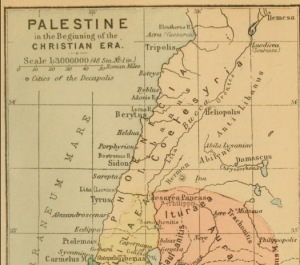
It is nearly fifty years since Edward Said denounced modern Zionists for their persistent efforts to silence and make invisible the Palestinians whose land they had largely appropriated. They clearly have not ceased in their efforts, for in recent months UK Lawyers for Israel (UKLFI) has pressured the Open University, the British Museum and probably other institutions to remove the word Palestine from old maps while promoting Judea and Samaria. Contrary to the report in the Daily Telegraph mentioned below, the British Museum’s decision to remove the name Palestine from two displays had nothing whatever to do with UKLFI pressure, and its management has no intention of altering the historical record merely to appease an Israel lobby group. But as this report in Middle East Eye explains, UKLFI is only interested in promoting Israel’s dominance of modern-day Palestine and is relentless in its efforts to obscure the history and very existence of Palestinians.
‘Erasing history’: British Museum criticised for removing references to ‘Palestine’ from exhibits
Move condemned by scholars and activists as part of a ‘systematic’ attack on Palestinian cultural identity.
Published date: 15 February 2026 16:11 GMT | Last update: 11 hours 52 mins ago
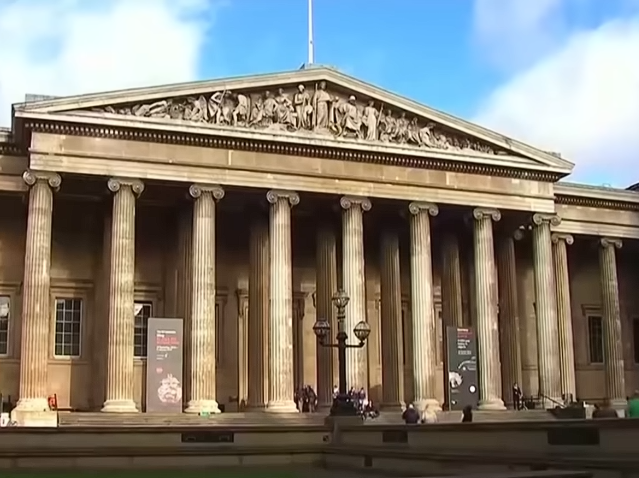
The British Museum has removed references to Palestine from its ancient Middle East displays, a move condemned by scholars and activists as part of what they describe as a “systematic” attack on Palestinian cultural identity and history.
The museum removed the term from exhibits on ancient Egypt and the Phoenicians, saying the word was not “meaningful” as a historical geographical term in that context.
According to the Telegraph, the move followed a letter from the controversial pro-Israel group UK Lawyers for Israel (UKLFI).
In its letter to museum director Nicholas Cullinan, UKLFI argued that using the term Palestine in the exhibits “has the compounding effect of erasing the kingdoms of Israel and of Judea” and “re-framing the origins of the Israelites and Jewish people as erroneously stemming from Palestine”.
The group specifically objected to labels in displays covering 1700–1500 BC that referred to the eastern Mediterranean coast as “Palestine” and described the Hyksos people as being of “Palestinian descent”.
A British Museum spokesperson denied that the move came in response to the UKLFI complaint.
It said the term – one of the earliest names associated with the region along the eastern Mediterranean – is “appropriate for the southern Levant” only in the later second millennium BC.
“We use the UN terminology on maps that show modern boundaries, for example Gaza, West Bank, Israel, Jordan and refer to ‘Palestinian’ as a cultural or ethnographic identifier where appropriate,” the spokesperson added.
However, academics who spoke to Middle East Eye said “ancient Palestine” is a historically accurate term for the region in antiquity.
“I use the term ‘ancient Palestine’ frequently in my own research and will continue to do so,” Marchella Ward, a lecturer in classical studies at the UK’s Open University, told MEE.
She added that claims the term is late-coming or illegitimate are a “lie” aimed at “the erasure of Palestinians and in support of Israel’s ongoing genocide against them”.
The campaign group Energy Embargo for Palestine accused the museum of hypocrisy, saying it positions itself as a guardian of artefacts and “the only institution able to preserve, protect and ‘objectively’ communicate their history”.
“And yet after looting Palestinian artefacts from across the Middle East, it is now unreluctantly preparing itself to rewrite history, to erase Palestine, and its millions of people, out of the history books,” the group said in a statement sent to MEE.
‘A very clear pattern’
Scholars and campaigners told MEE that the British Museum is one of a slew of public institutions, including councils and hospitals, targeted by UKLFI.
Earlier this month, it was reported that Encyclopaedia Britannica had amended several entries to Britannica Kids relating to Palestine, including the removal of the term from maps of the region, following pressure from UKLFI.
In February 2023, London’s Chelsea and Westminster hospital removed an artwork designed by school children in Gaza. UKLFI director Caroline Turner claimed that the move came in response to “patients’ complaints”. But a freedom of information request forced the hospital to admit that the only complaint submitted was by the UKLFI.
In January, the Open University (OU) also capitulated to the group’s demand to remove the term “ancient Palestine” from its future learning materials and to include caveats to existing content on the basis of it being newly “problematic”.
In February, OU staff wrote to the university’s vice chancellor demanding that the institution retract the commitments, highlighting that they could constitute a breach of its duties under the Higher Education (Freedom of Speech) Act 2023.
A forthcoming database compiled by the European Legal Support Centre (ELSC) documents 900 incidents of anti-Palestinian repression in the UK between January 2019 and August 2025.
It found that UKLFI appears in 128 of those cases, “as either a direct actor of repression or an enabling actor whose actions prompt workplaces, universities and other institutions to further repress solidarity with Palestine”.
‘What is surprising, and shameful, is that institutions, public bodies like the British Museum, are bending to this pressure’
– Giovanni Fassina, European Legal Support Centre
Giovanni Fassina, executive director of ELSC, said that UKLFI’s targeting of the British Museum “is not surprising” and part of a “very clear pattern” that the group has followed over the last few years of pressuring public bodies with “misleading” legal arguments.
“What we show is that UKLFI initiates these attacks by sending letters threatening legal action or alleging violations of UK law,” Fassina told MEE.
“Most of the time, the institutions comply with these requests or they may change their behaviour,” he said.
“What is surprising, and shameful, is that institutions, public bodies like the British Museum, are bending to this pressure,” Fassina added.
ELSC, together with the Public Interest Law Centre (PILC), have submitted a complaint against UKLFI to the Solicitors Regulation Authority (SRA) over the group’s use of strategic lawsuits against public participation (Slapps) to stifle expressions of Palestinian solidarity.
Slapps, the submission notes, are “legal actions, or threats of legal action, typically brought by powerful individuals or entities to intimidate, silence, or punish critics”.
ELSC and PILC also demanded that the group be regulated as a law firm.
In July 2025, Middle East Eye reported that the UK Charity Commission had confirmed that it was investigating UKLFI’s charitable wing, following complaints submitted by both Cage International and Led By Donkeys.
‘Accomplices to a political project’
Ward highlighted that the institutions bowing to this pressure “aid and abet Israel’s genocide of the Palestinians by agreeing to erase their history”.
“The rewriting of history has always played an important role in occupation and genocide. In Palestine itself, this takes the form of the colonisation and destruction of archaeological sites,” she told MEE.
“But these acts of violence alone are not enough to manufacture the historical narrative required for genocide,” Ward added, noting that “historians, museums and universities all function as accomplices to the political project that Israel is engaging in”.
Gaza’s cultural and religious heritage lies in ruins after a year of attacks by Israel
During its onslaught on Gaza, Israeli forces have fully or partially destroyed over 316 archaeological sites and buildings across the enclave, most dating from the Mamluk and Ottoman eras, with others dating from the early Islamic centuries and the Byzantine period.
Ismail al-Thawabteh, head of Gaza’s Government Media Office, said the attacks were “part of a policy aimed at erasing Palestinian identity” and that the destruction of Gaza’s heritage constituted “organised looting, a practice criminalised under international law and considered an assault on global cultural heritage”.
A UN report published in July last year found that Israeli attacks had damaged over half of all religious and cultural sites in Gaza, concluding that “Israeli security forces knew or should have known the locations and significance” of these sites and “should have planned all military operations to ensure no harm”.
The commission added that all 10 religious and cultural sites they investigated “suffered devastating destruction for which the commission could not identify a legitimate military need”, and that “artefacts were destroyed, removed or looted”.