

8 June 2026
Most reports of the crisis in the Middle East leave the impression that it is a male affair while the Palestinian women remain essentially passive. The publication of “Everything We Thought Was Beautiful: Interviews with Radical Palestinian Women” late last year by PM Press offers a useful correction. Here is a review by Dr Benay Blend from the website Thinking Palestine.
Everything We Thought Was Beautiful: Interviews with Radical Palestinian Women
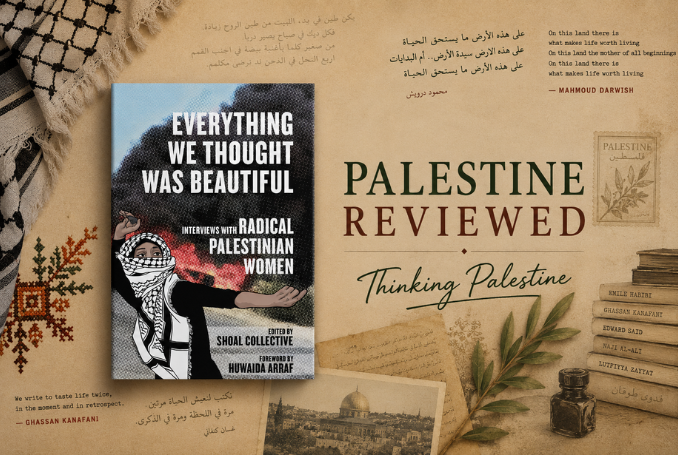
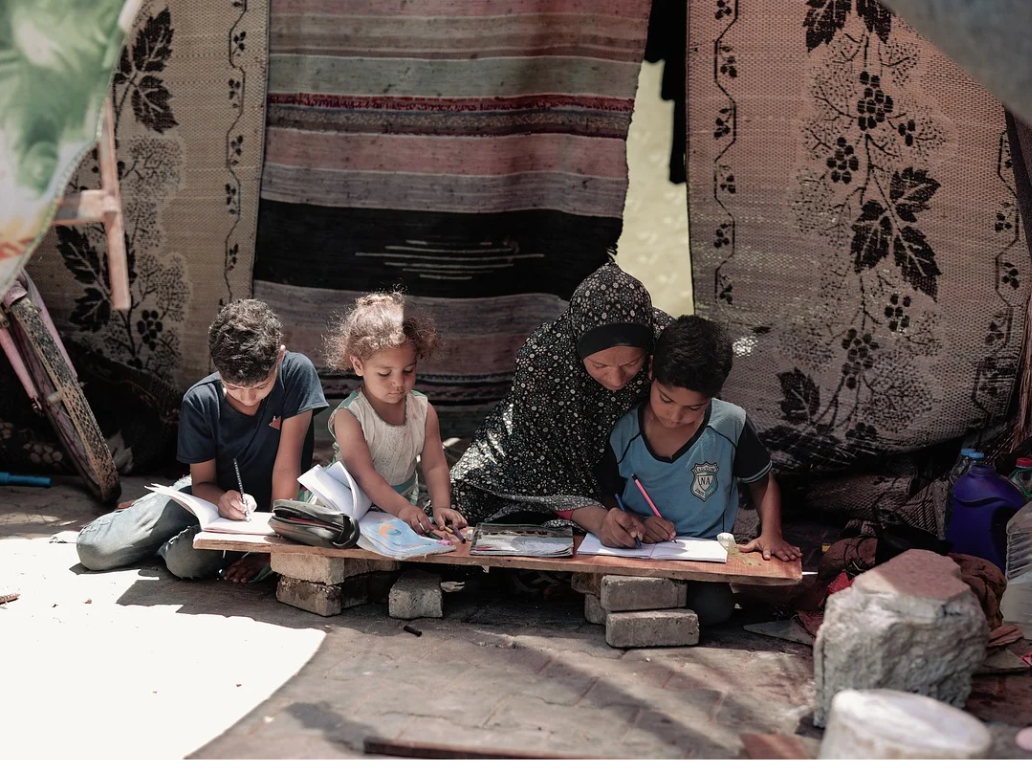
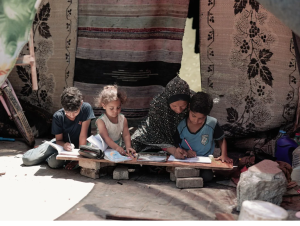
This collection challenges that framing by presenting women as organizers, intellectuals, journalists, artists, educators, and political actors. (Illustration: Palestine Chronicle)


By Benay Blend
What does resistance look like through the eyes of Palestinian women? Through conversations with activists, journalists, writers, educators, artists, and community organizers, ‘Everything We Thought Was Beautiful’ offers a powerful portrait of women whose lives and work are inseparable from the struggle for liberation, dignity, and return.
At a Glance
Title: Everything We Thought Was Beautiful: Interviews with Radical Palestinian Women
Editor: Shoal Collective
Foreword: Huwaida Arraf
Publisher: PM Press
ISBN: 9798887441450
Publication Date: 2025
Length: 200 pages
The Case for Reading It
Palestinian women are frequently portrayed as victims of war, occupation, and displacement. This collection challenges that framing by presenting women as organizers, intellectuals, journalists, artists, educators, and political actors whose experiences offer crucial insights into both the Palestinian struggle and broader movements for justice.
In Brief
Drawing on interviews conducted between 2018 and 2025, ‘Everything We Thought Was Beautiful’ brings together the voices of Palestinian women living across historic Palestine and the diaspora. Through conversations about resistance, feminism, journalism, disability rights, education, exile, and liberation, the collection offers a powerful portrait of political commitment, resilience, and collective struggle.
Readers’ Guide
Why should I read this book?
Because it allows Palestinian women to speak for themselves. Rather than interpreting their experiences through academic theory or media narratives, the book presents their words directly, creating an intimate and often deeply moving account of life under occupation and in exile.
Why is this book different?
The collection rejects simplistic portrayals of Palestinian women as either victims or symbols. The interviewees emerge as thinkers, organizers, writers, journalists, artists, educators, and community leaders whose political consciousness is shaped by lived experience. The result is not a book about Palestinian women, but a book with Palestinian women.
What are the most important themes in this book?
Liberation, feminism, resistance, solidarity, disability justice, journalism, exile, return, community organizing, anti-colonial struggle, hope, and political responsibility. Throughout the interviews, the contributors explore how gender, colonialism, class, and displacement intersect within Palestinian life.
Who are the Contributors?
The collection features interviews with Palestinian women from different generations, professions, and geographic locations, including:
Ayah Al-Ghazzawi – BDS activist from Gaza
Lina Nabulsi – organizer and activist based in Bethlehem
Samah Fadil – Black Palestinian writer and activist
Diana Khwaelid – journalist from Tulkarem
Shahd Abusalama – writer, artist, academic, and activist
Sireen Khoudairy – community organizer in Dheisheh refugee camp
Lama Suleiman – researcher and postgraduate student
Shrouq Aila – journalist
Rana Abu Rahmah – activist and organizer
Shatha Abu Srour – disability rights advocate
Ghada Hamdan – environmental and community activist
Mona Al-Farra – physician and humanitarian advocate
Faiza Abu Shamsiyah – activist and video journalist
Meet the Editors
Shoal Collective
Shoal Collective is an independent cooperative of writers and researchers whose work focuses on social justice, anti-colonial struggles, and movements for political change. Through journalism, analysis, interviews, and long-form investigations, the collective seeks to amplify voices often marginalized within mainstream political discourse. This volume continues that mission by foregrounding the experiences and perspectives of Palestinian women engaged in struggles for liberation and social transformation.
The Review
These interviews showcase the lives of Palestinian women who are participants in the struggle for freedom and liberation. Rather than passive victims as portrayed in Western media, they are “architects of resistance” (p. ix) within a broader movement against the Zionist Occupation.
“What will I benefit by calling myself oppressor a victim?” asks Shatha Abu Srour, a disability activist living in Beith Jala, Bethlehem. Instead of “get(ting) lost in this description or category,” Shatha prefers to convert her rage into action, joining other advocates for disabled Palestinians in the movement for liberation (p. 112).
Appropriately, the book is dedicated to the late journalist Wafa Aludaini, who was assassinated along with her husband and two children when an Israeli airstrike targeted her home on September 30, 2024. Shoal Collective had been hoping to schedule an interview with her in the weeks before her death.
Fearless, dedicated to the Palestinian cause, beloved by her family and friends, Wafa epitomized what it means to be a radical Palestinian woman. Despite the book’s diversity, each woman holds within her what Samah Fadil describes as their “Palestinianness” (p. 21), a political awareness that comes from being born within the context of longing for freedom and return.
“We’re born into a political situation when you are also in a colonial context,” explains Ayah Al-Ghazzawi, a Boycott, Divestment, Sanctions (BDS) activist from Gaza City (p. 4). Lacking a “political background” through her family, circumstances led her to become an activist (p. 4).
For Shahd Abusalama, an activist, writer, academic, and artist living in Barcelona, the term “activism” makes no sense. “Activism” for her, as for most Palestinians, is “almost a way of life” (p. 44). Unlike Al-Ghazzawi, Abusalama was born into a politically active family in which she learned that “oppression breeds resistance,” and that is “entrenched in the psyche of the Palestinians to reject and refuse” their circumstances (p. 44).
Linked by this common fold, several themes weave throughout the book, each with its own perspective depending on the interviewee’s experiences, location, age, vocation, etc. As Huwaida Arraf notes, the “strength of the movement lies in its diversity and inclusivity” (p. xi).
The bulk of the interviews were conducted between 2018 and 2025, during the escalation of Israel’s genocide. Nevertheless, the most prevalent theme throughout the book is the belief that liberation is inevitable as long as the people fight. It is the editors’ hope that the stories inspire, too, the global community, “not just to solidarity, but to action” (p. xi).
For Diana Khwaelid, a journalist working in Tulkarem in the West Bank, it’s simple. When asked how she manages to keep going after losing so many of her colleagues, she answers that “the truth must be told, and also [she] believe[s] the land, one day, will return to its owners” (p. 36).
Like others in this book, Sireen Khoudairy, now living in Dheisheh refugee camp in the West Bank, believes that “the occupation could destroy your house, they could put you in prison,” but they “can’t destroy your hope” (p. 69). If they succeed in doing that, then “you are occupied,” so she tries to always stay “above the occupation” (p. 69).
While living in Sheffield, England, Shahd Abusalama found hope in Palestinians who had never been to the homeland, but remained devoted to the struggle for liberation. For her, it was validation that the “roots truly run deep,” confirmation that the Zionist project had failed in its drive to erase memories of the homeland among the young (p. 48).
When asked about her preference for one form of politics over another, Abusalama replied that she associated feminism with a Western discourse that imposes its own interpretation without recognizing that the context is different in the Global South.
“Everything that we thought was beautiful” has been “hijacked,” she explained, thus providing the quote that gives the book its title (p. 49).
Nevertheless, Abusalama believes that “cultivating hope is a matter of survival,” thus finding something beautiful despite the obstacles. (p. 52).
“I know that no one comes out of such inhumane situations without being affected by such things,” Abusalama contends. “But we find consolation and power in solidarity,” (p. 47), another theme that runs throughout the book. “Hope is revived from these collective actions, from being confrontational against these normalized dehumanizations” (p. 47).
At Dheisheh refugee camp, Sireen Khudairy appreciates the kind of cooperation that she found while working there. “That’s what touched me,” she recalls, “that people have solidarity with each other. They support each other because they like to do it, not because they have to” (p. 72).
As a journalist, Shrouq Aila feels a personal responsibility to report the news. “If there is anything I can offer I will do it. It is my duty towards my homeland” (p. 91).
This sense of obligation was what Wafa Aludaini conveyed to me when I commented on her bravery in such dangerous conditions. Neither woman sought recognition for herself, but rather wanted to ensure that the “voices of the people” got a hearing (p. 91).
This notion of solidarity often crosses borders; other people blended into an intersectional movement that garners strength. “The liberation of Palestine is inseparable from the fight for gender justice,” writes Arraf, a connection that might be expected in a collection of women’s voices (p. xi).
Working on a permaculture farm named Om Sleiman, located in the village of Bil’in, Ghada Hamdan states that women face multilayered oppression stemming from the “patriarchal family construct” along with the abuses that everyone faces under the Zionist occupation (p. 121).
Nevertheless, Hamdan notes that women have always played an important role in the movement, from participating in armed struggle to working in the fields when men go off to the city to earn a living.
Viewed from a “revolutionary and Arab feminist” lens, these women are “more radical than most white feminists,” Hamdan notes, thus inviting readers to shed their misconceptions about Arab and Muslim women (p. 121).
Lama Suleiman, who at the time of the interview was continuing her postgraduate studies in Haifa, adds that there are different forms of feminism depending on experiences and world view.
“It’s different if you’re a Palestinian woman in an Israeli institution,” as Suleiman herself has been, “a woman living in a Palestinian village, or a Palestinian woman living in an Israeli city” (p. 81). There are also factors related to public vs. private spheres, she concludes, where each location might call for a different way of being.
For several of the women, there was a clear connection between the Palestinian struggle and those of other people. Following in the steps of the late writer/revolutionary Ghassan Kanafani, these interviewees believed global liberation movements had many points in common.
For Lina Nabulsi, residing in Bethlehem, on the West Bank, all struggles are the same. “We draw inspiration from freedom movements from around the world,” she says. “Black Lives Matter, the Zapatistas in Mexico and watching the women rise up in Egypt and Syria”—all of these movements, she states, help to make her stronger (p. 19).
As a Black Palestinian writer living in Montreal, Samah Fadil says that her background made her aware of these connections. Moreover, Fadil sees links between Canada as a settler colonial state that supports Israel, but she also calls attention to the protests around what the Canadian government has chosen to do (p. 25).
When asked what they wanted from the global community, most of the women called for more organizing, more recognition of the genocide that Israel is committing, rather than retreating to a position of detachment from the news.
For Nabulsi, putting the same pressure on the Palestinian Authority (PA) as on Israel is important. “If people want to end injustice,” she contends, then we must also end the injustice of the PA. It doesn’t matter if it’s the Israeli or the Palestinian soldier beating you; the results are the same” (p. 16).
Mona Al-Farra, a physician from Khan Yunis now living in Manchester, England, says that the international community has done a wonderful job of organizing demonstrations around the world.
“But it is not enough,” she warns, “because there are still people who don’t want to know about us, or they just close their eyes. These are individualistic people, who just want to carry on with their lives” (p. 137).
In the concluding interview, Faiza Abu Shamsiyah, residing in Tel Rumeida, discusses her role as an activist and video journalist. “My camera is my weapon,” she explains. In doing so, she hopes that she is showing “the voice of Palestinian society” from a woman’s point of view, because “it is always the men who talk” (p. 150).
This was the hope of the Shoal Collective, too, along with inspiring more internationals to join the movement for a free Palestine.
(The introductory material accompanying this review—including the book information, overview, and readers’ guide—was prepared by the Thinking Palestine editorial team.)
– Benay Blend earned her doctorate in American Studies from the University of New Mexico. Her scholarly works include Douglas Vakoch and Sam Mickey, Eds. (2017), “’Neither Homeland Nor Exile are Words’: ‘Situated Knowledge’ in the Works of Palestinian and Native American Writers”.