
11 January 2026
Here is a powerful account from Electronic Intifada of the utter determination of young Palestinians in Gaza to gain a higher education despite everything Israel has done over the past 30 years to destroy civilised life in this benighted land.
Going back to Gaza’s broken universities
Nadera Mushtha The Electronic Intifada 9 January 2026
On 13 November 2025, my family and I were breathlessly awaiting the results of my sister Aya’s high school exams, or tawjihi.
We put up some decorations in an apartment we had rented after relocating from Gaza City to Deir al-Balah, central Gaza, in September. We bought sweets, so excited to celebrate after what we had endured through death, bloodshed and bleak memories.
At 9 am, the results were announced – Aya received a score of 86 percent in the science stream despite the many internal displacements within Gaza City before we eventually moved to central Gaza.
We danced, celebrating a moment of immense joy, the first happiness to reach us after the October “ceasefire.”
Aya was among more than 30,000 other Gaza students born in 2007 to receive their tawjihi results that day while students born in 2006 – who should have received their results in 2024 – had received theirs on 14 October.
Universities in Gaza, which had been without a single new student throughout the entire genocidal war, opened registration for new students, especially 2006 and 2007-born groups, who studied and graduated together.
Despite the enormous devastation that struck campuses, universities like the Islamic University of Gaza, Al-Azhar University and Al-Aqsa University will resume on-campus education for specific groups of students.
The Islamic University announced that on-site education is only for first-year students, specializing in medicine, engineering, economics and administrative sciences, health sciences and English language while the rest of the students will continue online learning.
Nostalgia for university
On 20 November, I accompanied Aya to the Islamic University as she wanted to register.
Aya and I arrived around the afternoon at the university, a place I have not visited throughout the two years of genocide.
I wished my visit was to resume my studies on campus, but I was already waiting for my final results to receive my degree in education studies.
As we walked, I saw the murals on the wall of the Gaza headquarters for the UN agency for Palestine refugees (UNRWA).
The murals – near the university – are the same ones I used to gaze at from the taxi on my way to class. Thousands of students had seen them the way I did.
I wondered then: How many of those who once looked at these paintings are no longer alive?
Walking through the main gate, goosebumps and a sense of nostalgia stormed me.
I remembered how, after classes ended, students would crowd together in one spot, carrying their books, laptops and engineering tools, waiting for transportation while others would walk home with friends.
But what I saw wasn’t this place I once knew – it was rather peppered with tents here and there, displaced people’s clotheslines stretching between the walls and vendors displaying their products on campus at their sales stalls.
Hundreds of families who had lost their homes found refuge there, scattered around the campus – in the buildings, even in their ruined halls, and along the rubble-filled corridors.
The buildings were scarred by every form of destruction – most were completely destroyed while others were partially destroyed, but none were truly usable.
One of the most painfully absurd sights was a sign announcing a hair salon inside what is called the conference building, the auditorium of the university where graduation ceremonies used to be held.
As Aya and I kept walking, with every step, I was asking myself where I was, being unable to recognize the campus.
Even though it was my university where I spent two years, we needed displaced families to guide us to the building where new student registration was taking place – the building with the least damage.
When I entered, memories rushed back again. I remembered how the university used to overflow with life every year, with large groups of new students gathering and asking questions about specialties and programs.
Aya’s childhood dream was to study engineering, so we searched for the architecture program to inquire about its plan.
“Gaza needs engineers,” Aya told me.
Since Israel has visited unprecedented destruction upon our city, engineering students will have a vital role in rebuilding it.
Arduous studies continue
When I was preparing for tawjihi, the history teacher told us in one of the classes how education in Japan’s Hiroshima and Nagasaki didn’t take much time to resume as World War II ended.
I wondered then how that was possible with all the indescribable destruction the US nuclear bombs had inflicted.
But now I know, education is the place to start for anyone who wants to rebuild their lives and communities amid a genocidal war.
Gaza proved this: we kept learning even as the bombs fell around us
As a university student at the Islamic University of Gaza, I completed four semesters in one year from August 2024 to December 2025.
One semester followed the next with no breaks at all because the university wanted to grant every student the right to receive their degree at the time they were meant to.
Studying during the genocide was arduous.
I was displaced many times and lost my home, where I left my books and notes. And every time I tried to study, obstacles arose like the constant buzzing of drones and quadcopters, which would prevent me from concentrating.
Electricity was and still is scarce, and the internet connection was extremely weak – or absent altogether – as the Israeli army destroyed the headquarters of internet providers.
During my exams, which were held through an online platform, the internet would cut out sometimes, while at other times a neighboring house would be bombed, and smoke and shrapnel would pierce through ours.
But like thousands of other students, I kept going until graduation.
The determination of Gaza’s students to continue their education is proof that they love learning and believe in a future here.
Despite Israel’s attempts to extinguish them, they still see light ahead of them, rising from the unfathomable destruction to assert that this land is theirs.
But even now, students’ studies are arduous.
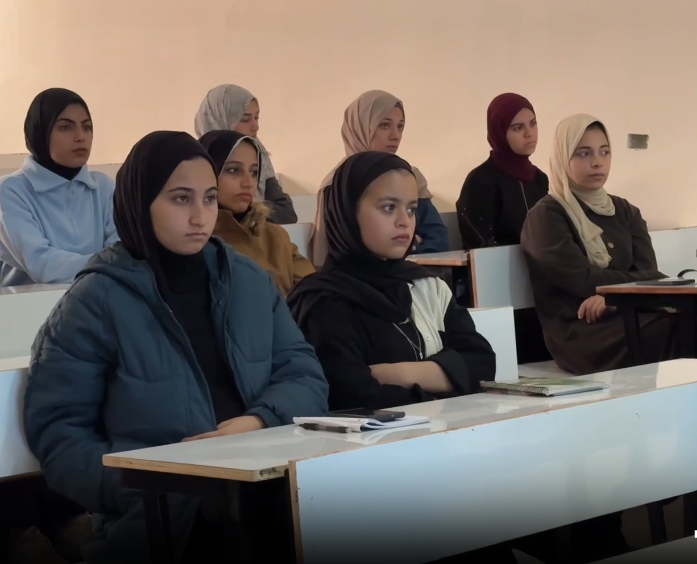
As students continue to study and attend their lectures on site at the Islamic University, Aya tells me how she and other first-year students face many obstacles.
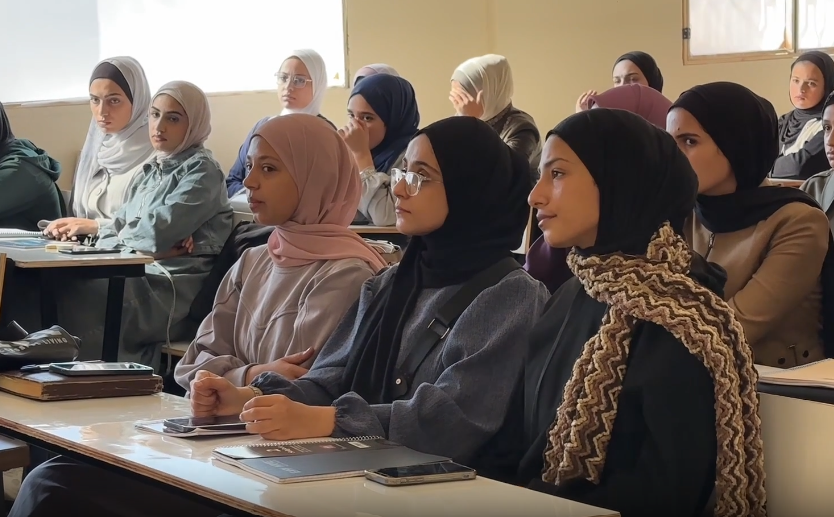
The halls are full of students, where there isn’t enough room for all of them.
“All the engineering students born in 2006 and 2007 are together in the same hall,” Aya told me.
And not all courses are available on campus as most of the buildings are destroyed.
Aya and all her fellow classmates are all studying in one building.
Yet they persevere.
Nadera Mushtha is a teacher and writer in Gaza.