



12 January 2026
BRICUP has joined PSC, Greenpeace, the TUC, Liberty and some 40 other civil society groups to oppose the government’s latest proposal to expand police powers over public demonstrations. As before, the powers are extremely ill-defined and therefore certain to be used arbitrarily. One other thing is absolutely certain: they are mainly intended to suppress demonstrations in support of Palestinian human rights and will be used against them. The Guardian report, followed by the PSC statement including a list of supporting groups, are reprinted below.
Civil society groups condemn ‘dangerous’ plans for more anti-protest powers
Dozens including TUC join force to oppose ‘wide-ranging’ move to increase police powers in England and Wales
Haroon Siddique Guardian Legal affairs correspondentMon 12 Jan 2026 05.00 GMTShare
More than 40 civil society groups including the TUC, Greenpeace and the Palestine Solidarity Campaign have joined forces to oppose “dangerous” plans to increase police powers to ban protests in England and Wales.
They said an amendment in the crime and policing bill, which would require police to consider the “cumulative impact” of repeated protests in the same area when imposing conditions on demonstrations, represented a “draconian crackdown on our rights to freedom of expression and assembly”.
In a joint statement, published on Monday, the groups, which also include Amnesty International UK, Liberty, Quakers in Britain and the National Education Union, said: “The size of an ‘area’ is not specified, and police are not required to take into account whether the protests are for the same cause or involve the same people.
“Although government statements make clear these powers have been brought forward in response to the mass national marches for Palestinian rights, the impact of this change of law would be wide-ranging.
“An anti-racist march could be blocked from Whitehall because of a previous farmers’ protest, or a pride march restricted because a far-right demonstration was recently held in the same town.”
When announcing the new police powers in October, the home secretary, Shabana Mahmood, said repeated large-scale demonstrations over Gaza had caused “considerable fear” for the Jewish community after a deadly terror attack on a synagoge in Manchester.
Ben Jamal, the director of the Palestine Solidarity Campaign, said: “Instead of addressing its responsibilities under international law [with respect to Israel’s actions in Gaza] and addressing the core demands of the protestors, which are supported according to opinion polls by a majority of the British public, successive governments have instead sought to repress protest through ever more draconian laws.
“The right to protest – including in solidarity with the Palestinian people or in opposition to the policies and actions of the British government – is a precious democratic principle that is under the gravest threat and must be defended.”
The joint statement, which was also signed by other trade unions, charities, NGOs, faith, climate justice, and human rights organisations, called on the government “to immediately drop its dangerous proposal”.
Lyle Barker, a policy and campaigns officer at Liberty, said: “The government must stop introducing new anti-protest powers until the review of current laws has taken place – and instead work to protect our basic human right to make our voices heard when those in power refuse to listen.”
The joint statement said the civil rights movement, the campaign for women’s suffrage and the movement against apartheid in South Africa all relied on the “cumulative impact” of repeated protests over many years. It added: “No protest movement has ever brought about change through a one-off demonstration.”
Paul Nowak, the general secretary of the TUC, said: “Restrictions on the right to protest are a major concern for the trade union movement in this country. With the far right on the rise in the UK and across the globe, we must be extra vigilant in defending basic human rights and democratic norms.”
A Home Office spokesperson said: “The right to protest is fundamental to our democracy, and it is a long-standing tradition in this country that people are free to demonstrate their views.
“These new powers will not ban protests, but they will help protect communities from repeated disruption while protecting the right to peaceful protest.”
Defend the Right to Protest Civil Society Statemen
PSC Posted on January 12, 2026
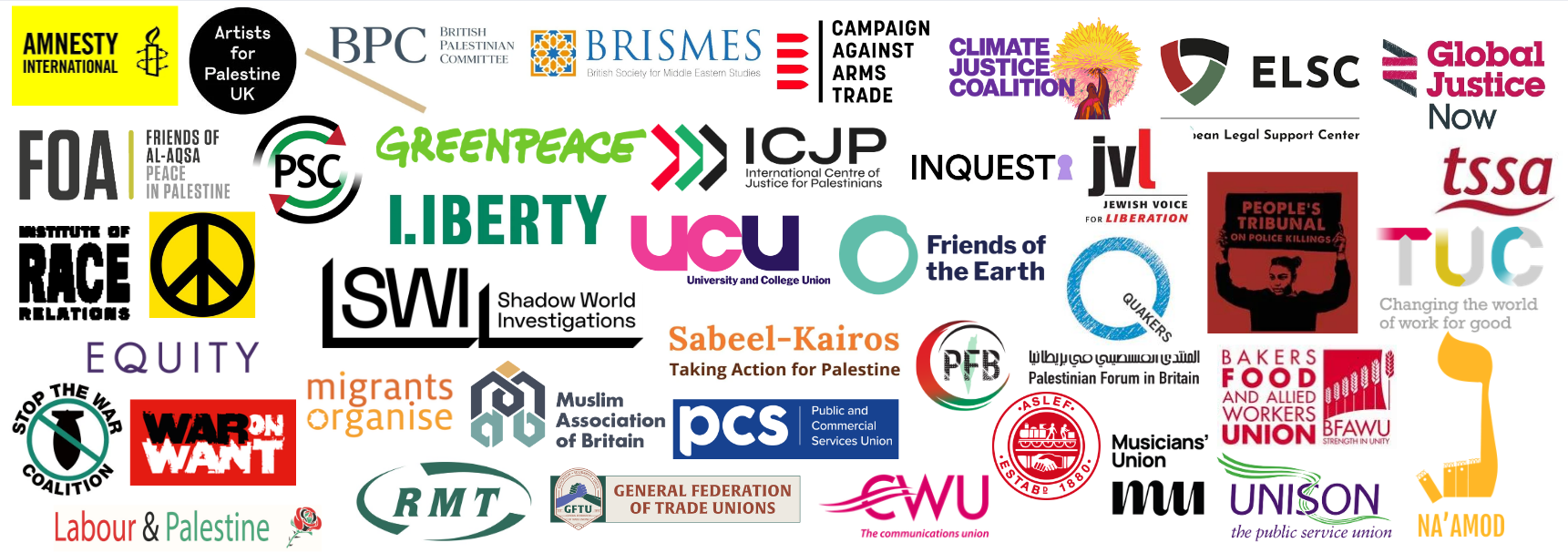
As a group of civil society organisations made up of trade unions, charities, NGOs, faith, climate justice, human rights, cultural, campaigning, and solidarity organisations, we believe that the right to protest is precious and should be defended. We therefore oppose the government’s draconian crackdown on our rights to freedom of expression and assembly.
The government has introduced an extreme proposal to give police new powers to restrict protests based on their so-called ‘cumulative disruption’. If this becomes law, the police in England and Wales will be required to consider any past protests or planned future protests in the same ‘area’ when deciding whether to impose restrictions. The size of an ‘area’ is not specified, and police are not required to take into account whether the protests are for the same cause or involve the same people.
Although government statements make clear these powers have been brought forward in response to the mass national marches for Palestinian rights, the impact of this change of law would be wide-ranging. An anti-racist march could be blocked from Whitehall because of a previous farmers’ protest, or a pride march restricted because a far-right demonstration was recently held in the same town.
Effective protests often recur in the same or similar places, for example, a seat of power like Westminster or Downing Street. No protest movement has ever brought about change through a single demonstration. Britain’s democratic system itself is the outcome of successive waves of protest – the civil rights movement, the campaign for women’s suffrage and the movement against apartheid in South Africa all relied on the ‘cumulative’ impact of repeated protests over many years.
Clamping down on peaceful protests will not protect anyone’s rights or safety, and we reject cynical attempts by government to present this repressive proposal as protection for vulnerable groups. These measures could be used by this, or any future government, to effectively stamp out political demonstrations, actions linked to industrial disputes and protests altogether.
The right to protest must be defended. We call on the British government to immediately drop its dangerous proposal and repeal the succession of anti-protest laws on which it builds.
Amnesty International UK
Artists for Palestine UK
Associated Society of Locomotive Engineers and Firemen (ASLEF)
Bakers Food and Allied Workers Union (BFAWU)
British Palestinian Committee
British Society for Middle Eastern Studies
Campaign Against Arms Trade
Campaign for Nuclear Disarmament
Climate Justice Coalition
Communication Workers Union (CWU)
Equity
European Legal Support Centre
Fire Brigades Union (FBU)
Friends of Al-Aqsa
Friends of the Earth England, Wales and Northern Ireland
General Federation of Trade Unions (GFTU)
Global Justice Now
Greenpeace
INQUEST
Institute of Race Relations
International Centre of Justice for Palestinians
Jewish Voice for Liberation
Labour & Palestine
Liberty
Migrants Organise
Musicians’ Union
Muslim Association of Britain
Na’amod
National Education Union (NEU)
National Union of Rail, Maritime and Transport Workers (RMT)
Network for Police Monitoring
Palestine Solidarity Campaign
Palestinian Forum in Britain
Public and Commercial Services Union (PCS)
Quakers in Britain
Sabeel-Kairos UK
Shadow World Investigations
Stand up to Racism
Stop the War Coalition
The People’s Tribunal on Police Killings
Trades Union Congress (TUC)
Transport Salaried Staffs’ Association (TSSA)
UNISON
University and College Union (UCU)
War on Want