

21 October 2026
The new Amnesty International report constitutes a comprehensive condemnation of UK universities for their arbitrary and repressive response to student protests against the genocide in Gaza, and deserves to be read in full. The following is Amnesty International’s executive summary: the original can be found here.
UK: Universities silencing pro-Palestinian solidarity among students and academics
Posted 20 October 2026
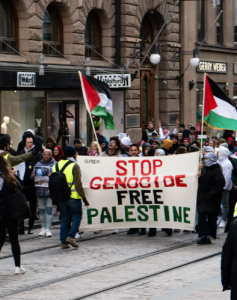
- A new report by Amnesty International shows that a number of prominent UK universities have suppressed pro-Palestinian solidarity amongst academics and students.
- Students and academics at some universities have faced sanctions, including suspensions, campus bans, and threats to their visa status for actions as simple as chanting, clapping and wearing keffiyehs.
Overview
““This is an attack on our freedom of speech and the right to protest from the very institutions who are supposed to encourage free thought.”
Kerry Moscogiuri, CEO of Amnesty International UK
A new report by Amnesty International shows that several UK universities have restricted solidarity with Palestinian people among students and academics, including speech that could be perceived as critical of Israel.
On this basis, universities have cancelled meetings and events, framed peaceful protest as ‘disruption’, shut down encampments and taken pre-emptive punitive measures, among other things, with the actions taken varying amongst universities.
The research covered events from 7 October 2023 to 30 September 2025, while also examining the preceding 18 months to contextualise patterns of practice. Different universities responded in different ways and our inclusion of particular case studies does not imply that the measures documented were more widely representative. While each finding of an interference or violation of rights in the report was present in at least one (and sometimes more) case studies, not all human rights concerns and violations noted below were present across all 26 case studies in this report or at each university.
Amnesty International has found that the restrictions highlighted in case studies documented in the report often didn’t meet the high bar in international and UK law for interfering with political speech and peaceful assembly.
Report findings
The report finds that students and academics have been sanctioned for actions like chanting, clapping and wearing keffiyehs. These sanctions have included suspensions, campus bans, withdrawal of degrees and threats to visa status, often causing great personal harm. Students who are visibly Muslim and those displaying symbols of Palestinian identity have been disproportionately impacted.
In several cases, sanctions were imposed before disciplinary hearings had concluded, effectively transforming precautionary measures into punishments and contributing to the chilling effect. In some cases documented in the report, universities prolonged investigations without clarifying timelines, outcomes or routes for appeal. These prolonged investigations combined with campus bans, restricted access to services, and uncertainty about potential outcomes – had severe impacts on people’s education, mental health and future prospects.
Amnesty International found that some universities have relied on overly broad disciplinary codes to restrict solidarity actions, such as by unduly characterising protests as ‘disruptive’, or ‘offensive’, with no apparent evidence of targeted harm. The report finds instances of universities treating peaceful protest as trespass, even in spaces such as campus squares, foyers and union buildings which have been used for protests for decades. Some have adopted measures that require advance approval for protests and others have resorted to court injunctions which impose blanket bans across large parts of campus, exposing students and staff to risk of fines and imprisonment for engaging in protest.
Kerry Moscogiuri, CEO of Amnesty International UK said:
“This is an attack on our freedom of speech and the right to protest from the very institutions who are supposed to encourage free thought.
“Students and academics care about the victims of Israel’s genocide in Gaza. It’s beyond belief that some of our prominent universities see this as a threat that requires punitive measures like court injunctions, and harsh punishments that leave students with their lives turned upside down.
“This is part of a wider crackdown on communities coming together to make their voices heard on Israel’s genocide of Palestinians in Gaza and other issues they care about. Just as we’re seeing students facing sanctions for clapping and chanting on our campuses, we’re seeing grandparents, amongst many others, facing arrest for holding placards at the Defend Our Juries protests.
“Universities should be an environment in which students feel safe in coming together and demonstrating on the issues they care about. That’s why we are asking universities to commit to our Defend Dissent Charter.”
An attack on free speech
UK universities are not acting in isolation when responding to Palestine solidarity protests, but are operating within a network which encouraged repressive responses. Their responses reflect sector-wide practices, shaped by direct government pressure, regulatory direction, lobbying by advocacy groups, and advice from private law firms and security contractors.
Some universities have shared legal strategies, received instructions from the Department for Education, and shared their security planning with the effect of clamping down on those perceived to be showing support for the victims of Israel’s apartheid and genocide in Gaza.
In cases profiled in this report, Palestine-related expression frequently came under greater scrutiny, or appeared to have been regulated differently from the way that other student protests at universities might generally be regulated. Students and staff who are Palestinian, Arab, Muslim and from other racialised communities, as well as students who are not British nationals, have experienced particular and disproportionate impacts.
Twenty-two-year-old student Usama Ghanem was suspended by Kings College London in 2025 over his involvement in pro Palestinian activism, and told to ‘return to [Egypt] during this period of suspension’, where he had previously been detained and tortured. His suspension was lifted after review in September 2026.
Usama said: “I left an authoritarian regime in Egypt to find one at King’s College London. For protesting a genocide our university was funding and demanding divestment, I was indefinitely suspended, monitored, and threatened with deportation to the very authoritarian regime I had fled. As a lead negotiator for our Palestine encampment, I saw King’s discipline 25 other students too. This was about more than punishment, it was an attempt to intimidate us into silence. A university should protect dissent, not surveil and punish students for challenging its complicity in genocide.”
Some of the cases featured in the report include:
Oxford
Students at the University of Oxford launched a series of protests in solidarity with Palestinians, culminating in two encampments beginning in May 2024. These protests sought both material and symbolic change, including university divestment from companies supplying arms to Israel. According to the students, the protests were peaceful, yet the university responded with a multi-pronged disciplinary approach. This included calling the police and prolonged disciplinary investigations, imposing restrictions on access to university buildings, libraries, and facilities, and requirements to seek permission to attend academic activities for students involved in the protests.
Cambridge
In March 2025 the University of Cambridge sought a wide-ranging court injunction to prohibit protests in solidarity with Palestinians in several prominent locations on its campus – areas that have long served as focal points for student activism. The application followed a series of peaceful protests and vigils organised by groups expressing solidarity with Palestinians. Citing safety concerns, public order, and reputational risk, the university argued that restrictions were necessary in areas including King’s Parade, Senate House Passage, and the vicinity of the Old Schools – locations of symbolic importance for student-led political expression. Legal representatives and civil society groups criticised the breadth and duration of the proposed order, describing it as a sweeping and pre-emptive restriction that risked criminalising peaceful protest and chilling lawful dissent.
London School of Economics and Political Science (LSE)
On 7 July 2024 seven students at the LSE took part in a peaceful protest calling for the university to divest from companies supplying arms to Israel used in committing human rights violations against Palestinians. The protest was held inside the LSE Student Services Centre foyer and lasted about 15 minutes before it was dispersed. The university alleges it lasted 25 minutes. Students wore keffiyehs and t-shirts with red handprints symbolising blood, used a megaphone, and chanted slogans.
LSE subsequently wrote to the students informing them that it had imposed precautionary campus bans on them. Online access to wellbeing services was permitted, but in-person wellbeing support was restricted – although this was later adjusted. Student medical services are located on campus and one student reported difficulty accessing medical care, as attending an appointment would have required breaching the campus restriction.
The university justified the disciplinary measures to the students in part by citing witness statements that highlighted the date of the protest – the anniversary of the 7/7 London bombings. According to internal documents disclosed under a Subject Access Request (SAR), some staff claimed the date made the protest feel intimidating. Internal LSE emails obtained via SAR reveal how the protest was characterised within the institution during the disciplinary process. Communications from senior university leadership described the protest as a ‘temper tantrum by children’ and referred to students as ‘dressed as terrorists’. One official proposed expelling the students before an investigation had even taken place.