







6 March 2026
Nicola Perugini (pictured) and Shaira Vadasaria have written a remarkable article on the University of Edinburgh’s complicity in the nightmare that Palestinians have suffered since the promulgation of the Balfour declaration, issued while Arthur Balfour was Chancellor of the University. The article merits the attention of all BRICUP supporters, but it begs the question whether other British universities should also be investigated as carefully for their complicity in imperial racist aggression including in the Middle East. The original article article can be found here in the Journal of Palestine Studies.
Balfour University: Race, Imperial Education, and the Declaration on Palestine
Pages 26-50 | Received 09 May 2025, Accepted 26 Aug 2025, Published online: 18 Feb 2026
Abstract
This article discusses the University of Edinburgh’s racial entanglement with the British Empire and settler colonialism in Palestine through the figure of its former chancellor, Arthur James Balfour. It explores two intertwined aspects of Balfour’s legacy: his role as a statesman who advanced racial policies and settler-colonial dispossession in Palestine, and as an academic leader who promoted race thinking and imperial education. The analysis situates the 1917 Balfour Declaration within these overlapping domains, showing how Balfour’s imperial and academic roles were inseparable. It analyzes the declaration as not solely a matter of historical harm, but as a formative moment in the longue durée of the university’s entanglement with imperialism and Zionist settler-colonial violence enacted in Palestine. Edinburgh’s student and staff mobilization against the genocide in Gaza exposed this historical nexus, revealing how institutional legacies of colonial and imperial violence remain present even within so-called moments of racial and decolonial redress.
During the spring of 2020, at the height of the COVID-19 pandemic and Black Lives Matter (BLM) global protests, a renewed sense of political consciousness emerged in large parts of the Global North across a spectrum of political sensibilities. The killing of Breonna Taylor, a twenty-six-year-old Black woman shot by US police officers in her own home, and the 9 mins., 29 secs. lynching of George Floyd, a forty-six-year-old Black man killed in broad daylight by asphyxiation with a police officer’s knee to his neck, were two cases among many that evidenced the routine constancy in which Black life is rendered disposable and killable.Footnote1 Neoliberal corporate responses immediately capitalized on the momentum by celebrating the BLM movement and promoting so-called decolonizing initiatives, which, in the context of higher education, coalesced with a resurgent wave of student- and faculty-led movements for racial justice. An uncanny constellation began to form, bringing together forces with different political inclinations around anti-racism, from critiques of white supremacy via abolition of policing and prisons, to a surge in equality, diversity, and inclusion (EDI) initiatives.
At the University of Edinburgh (UoE), this period raised questions around the university’s direct and indirect involvement in the Atlantic slave trade through financial investments in plantations and the exchange of epistemic knowledge. As a leading Western academic institution established firmly in the era of colonial modernity and consolidated under the rise of the British Empire, some of the most notorious racial scientists, physicians, architects of colonial settlements, positivist sociologists, and political philosophers developed their racial views about the world at UoE, working hand in hand with military and imperial administrative servants. This included some of the university’s esteemed alumni and former faculty and students, such as Charles Darwin, David Hume and Patrick Geddes, all of whom introduced ideas that came to justify and naturalize systems of racial hierarchy. These racial views were not simply a matter of individual prejudice or cultural norms of an era, as their apologists like to proclaim. Rather, these viewpoints shaped imperial reason and helped institute and prolong systems of racial and economic domination under modern colonial and imperial rule that have lasting impact in the present. As the racial legacy of such figures began to surface, UoE took some swift actions, including the decision to rename some of its buildings. In September 2020, after a petition was addressed to the university’s senior leadership about Hume’s racist worldviews,Footnote2 the David Hume Tower was renamed 40 George Square. UoE seemed to be on some kind of path toward recognition of its historical wrongs.
By the end of 2020, and amid this political climate of racial redress, we came to notice another one of UoE’s skeletons. Out of curiosity, we opened the university chancellor’s official webpage. As we scrolled through the list, we read: “1891–1930: Earl of Balfour.”Footnote3 Between 1891 and 1930, Arthur James Balfour presided as chancellor of the University of Edinburgh. The timeline around Balfour’s appointment was striking not only because he was the second longest serving chancellor since the inception of the university in 1583. It was also during his appointment at UoE that he decisively contributed to the racialization of the Palestinian people who, through his 1917 declaration, came to cast the Palestinian people outside of the legal parameters of “personhood” by negating their national sovereignty as a people with political rights to self-determination on their land.Footnote4 The strategic wording of his 1917 declaration came to authorize a historical process of race making through dehumanizing Palestinians as a people incapable of self-governance. The final draft of what would come to be known as the Balfour Declaration was adopted almost immediately into the British Mandate for Palestine and, unlike other wartime statements, inscribed verbatim.Footnote5 We asked ourselves: If university leadership would rename a building because of Hume’s irredeemable views on race and slavery, how might they respond when asked to account for the fact that their own chancellor, while in post, issued a “false promissory note”Footnote6 that categorically set into motion a century-long process of imperial expansion, settler-colonial dispossession, and racialization in Palestine by means of forced displacement, ethnic cleansing, occupation, apartheid, and genocide? So began our research into UoE’s entanglements with the question of Palestine, Zionism, and settler-colonial dispossession.Footnote7
In UK academia, the roles of chancellors and other institutional appointees are often dismissed as simply ceremonial, lacking weight or influence. In our encounters, such claims are especially prominent when institutions are asked to account for their historical records of violence. The past deeds of such figures are exempted from scrutiny or institutional accountability in the present, their erstwhile views excused as signposts of a historical time and culture that normalized racial and colonial sensibilities. But such appointments were made at a time when institutions of higher education were at the fore of advancing imperial knowledge in service of the British Empire, and as a means of governance and domination within its colonies. The ongoing imperial and settler-colonial attempts at annihilating Palestinians as a group reveals the violence of Balfour’s legacy in the present and compels us to reckon seriously with this genealogy. We would be remiss if we ignored this continuity.
During the nomination speech of Balfour to the chancellorship on October 31, 1891, Vice Chancellor Alexander Campbell Fraser defined the role as “the supreme head of the university.”Footnote8 In the speech, Fraser also likened Balfour’s public and intellectual life to English philosophers like John Stuart Mill, and described Balfour as a “remarkable combination of intellectual power and high academic sympathies,” coupled with “practical statesmanship, which was too rare in the annals of our English history.”Footnote9 Today, the chancellor still represents one of the highest positions in the institution and aims to enhance “the profile and reputation of the University on national and global levels.”Footnote10
Balfour’s academic associations and institutional roles were intimately tied to his racial worldviews. Indeed, as evidenced in his domestic and foreign imperial policies, Balfour the imperial statesman and Balfour the university chancellor were hardly separable. The very tenure of his appointment as chancellor coincided with the years in which he played a decisive role in Britain’s imperial foreign policy—at the height of British empire, no less. What connected his various political and academic careers, including his chancellorship at UoE and the University of Cambridge (UoC) from 1919 to 1930, and his role as president of the British Academy (1921–28), was his philosophical commitment to the development of racial thought in support of imperial projects advanced under the British Empire. It was this duality between his political and academic appointments that made him an ideal candidate to serve as chancellor, being at once a scholar and a well-positioned figure of public affairs.Footnote11
This article highlights these two interconnected elements of his biography—namely, Balfour’s racial thinking and policies as a statesman, where he instituted a process of settler-colonial dispossession in Palestine, and second, Balfour as an institutional academic who dedicated himself to the promotion of race thinking and imperial education more widely. In this twofold role, he signed the declaration that would come to be named after him, and which inaugurated a process of dispossessing Palestinians. Critical scholarship on the Balfour Declaration—and on Balfour more generally—has largely overlooked the significance of this twofold role. Scholars and biographers have mostly focused on Balfour the statesman, and when they have addressed Balfour the “man of science,” they have tended to compartmentalize it from his political career.Footnote12 In this article, by contrast, we situate our analysis precisely at the intersection of his dual careers, exploring their encounters, overlaps, and interconnections as a productive space for thinking about institutional accountability.
We read Balfour’s legacy, and student and staff calls for accountability at UoE since the start of the genocide, through an active divestment campaign and a reparative justice process titled “Decolonised Transformations: Confronting the University’s Legacies of Slavery and Colonialism.”Footnote13 Drawing on David Scott’s engagement with reparatory history as a method of genealogical critique, we revisit the Balfour Declaration, the divestment movement, and the Decolonised Transformations Project and its relevance to ongoing struggles for Palestinian reparation, by recomposing the scattered fragments of Balfour’s engagement with governmental policies, scholarship, public intellectual life, and philosophical writing on race and imperialism.Footnote14 By reading the 1917 declaration alongside Balfour’s wider racial career and alongside mobilization in support of Palestinian self-determination at UoE, we consider what is at stake when the academy enters into the arena of reparatory history and racial redress to the question of Palestine.
The article is organized into four parts. First, we contextualize the political terrain upon which both the divestment movement and Decolonised Transformations developed and overlapped, despite emerging from different trajectories and constituents of the university. Next, we analyze the Balfour Declaration and its repercussions in Palestine, historically and to the present day, and reread it as emblematic of Balfour’s wider racial career, including his antisemitic legislation and his academic associations, circles, and appointments. We read these connections alongside the development of Balfour’s racial thinking and policies as a statesman that systematically targeted Palestinians, South Africans, and Jewish immigrants in Britain at the very time that he was serving in the ranks of the British Empire and representing UoE. We then turn to Balfour’s one and only visit to Palestine in 1925, eight years after the signing of the declaration and the military conquest of the country by British General Edmund Allenby, who would likewise be celebrated by UoE. We analyze how, during this visit, Balfour inaugurated the Hebrew University in Jerusalem as part of his broader commitment to the development of imperial education and racist ideas around civilizing the so-called Orient. The fourth and final section describes the imperial afterlife of Balfour at UoE amid the genocide, and student and staff’s protests and demands for divestment.Footnote15 Building from Stuart Hall’s concept of conjuncture, we introduce the Balfour conjuncture as a method for analyzing the multifaceted forces shaping ongoing racial, settler-colonial, and imperial politics around the question of Palestine within higher education, and as a tool for intervening in and challenging them.Footnote16
Divestment and Decolonized Transformations: Reparative Justice in a Time of Genocide
Following Hamas’s armed resistance operation on October 7, 2023, which broke Israel’s seventeen-year siege of Gaza and ushered in its war of annihilation, university campuses across the world became settings of unprecedented community mobilization for Palestine. The surge in student encampments and renewed calls for divestment marked a new era of Palestine solidarity praxis. These movements owe their ethical inheritances and political debts to a century-long Palestinian liberation struggle that drew from preceding anti-colonial movements and echoed throughout the era of third-world internationalism. We must understand present-day student encampments and divestment campaigns as part and parcel of these longer traditions of Global South resistance, refusal, and affirmation of the right to self-determination. Inspired by the longue durée of Palestinian defiance through boycotts, revolt, hunger strikes, uprisings, and other forms of resistance, the student-led encampments following October 7, which were supported by many university staff, deployed a diversity of tactics to hold universities to account for their complicity in the ongoing genocide in Gaza and their wider investments in the political economy of Israeli settler colonialism. Though varied, university administrative responses to student encampments reproduced the same liberal and at times fascist logic constitutive of decades of Western discourse and reactions to the struggle for Palestinian liberation. Rather than genuinely addressing the global demands for justice for Palestine, academic institutions complicit in Israel’s settler-colonial dispossession reacted through a combination of genocide denial, the frequent adoption of repressive measures in coordination with state apparatuses, and the implementation of bureaucratic processes aimed at managing protests and preventing divestment.
By October 2023, we were three years into active community mobilizations on UoE’s links to Palestine, conducting archival research at the university’s Centre for Research Collections, alongside other Scottish archives. After October 7, our campus became one of the UK’s epicenters of academic protest against the genocide. Students and staff coalesced in a multi-racial and multi-religious alliance that carried out a sustained divestment campaign led first and foremost by the student encampment.Footnote17 As a result of the political pressure of the divestment movement on our institution, UoE finally included Palestine among the questions to be examined in the Decolonised Transformations Project.Footnote18 This initiative, commissioned by UoE’s vice chancellor in 2021 as a “sector-leading” effort aimed at strengthening the university as a global institution,Footnote19 was structured around two main components. The first was a research-focused working group led by “distinguished scholars on issues of race and racism,” which also included student representatives and racialized community members from outside the university.Footnote20 The second component was a community engagement program focusing on reparatory justice both as a participatory process involving racialized communities and as the central goal of the initiative. In addition, a steering group was created to advise the working group on research and community engagement activities. The group was led by the late Sir Geoff Palmer, a former alumnus of UoE and Scotland’s first Black professor, who died shortly before the release of the group’s report in July 2025. The steering committee also involved other alumni, including donors to the university.
Initially, the project opted not to include Palestine in its remit despite our encouragement. Following pressure from the divestment struggle, in which students and staff asked for acknowledgment of the university’s relationship to Balfour and his actions, alongside divestment and reparations from what they renamed as “Balfour University,” senior leadership made a concession. For the first time in history, a Global North academic institution brought Palestine within the remit of a university reparative justice inquiry into historical wrongs committed by the university. This period was marked by an unprecedented conjuncture of events and a powerful assemblage of epistemic and political forces galvanized by the student- and staff-led anti-genocide and divestment movement at UoE. It was this constellation of forces that led to the inclusion of Palestine in the academic review of our institution’s entanglement with slavery and colonialism. Our contribution to this review—which brought into view a section of the report titled “University of Edinburgh and the Question of Palestine: Balfour’s Imperial Legacy and Its Afterlife”Footnote21—was rooted in our involvement in the Palestinian divestment movement and research into Balfour’s imperial practices and racial worldviews.
We entered into this reparative justice inquiry not because we believe that any meaningful or easy repair can be done to redress a century of dehumanization and dispossession of Palestinians. To ameliorate the wreckage, incalculable racial horror, grief, and loss that political Zionism and its colonial and racial supremacist ideology have cast upon Palestine and on its Indigenous people from the river to the sea and beyond, feels an impossible task. There is no sanitizing this institutional record. The litany of horrors remains with us. The reconstitution of Gaza as a death world marks a world of no return—not for the hundreds of thousands who have been martyred, nor for those tortured and maimed, nor for those who might survive this mass slaughter and face the consequences of forced starvation. Those who do survive will inherit an afterlife marked by genocide, in the absence of kin, limbs, homes, and the sanctity of life itself. These unconscionable horrors belong to us all now and we live with them. There is no coming back from this, and certainly no reparative formula to heal this moment or the century of colonial dispossession of Palestine and Palestinians. Nonetheless, justice and accountability for Palestine remain at the core of a just and free world. It is an ethical imperative and a political compass for crafting a different world order entirely, free from imperialism, colonialism, and interconnected forms of domination. Reparation for us is about accountability and building alliances with subjugated peoples, and with all the communities in struggle against hegemony and systems of domination. For this reason, we entered the reparative justice process by way of duty, as a way to mobilize and at the very minimum, ensure the cessation of the university’s ongoing harm through its investments in the genocide and ties to Israel’s settler-colonial economy.
As David Scott’s work on the moral and reparatory history of New World slavery helps us understand, the meaning of reparatory history is not only about reckoning with past evil but also present debts. For Scott, it is about the political repair of moral debt. As he explains, “unrepaired wrong remains wrong and, moreover, that the unrepair of such wrong is itself a grievous wrong requiring redress in conjunction with the repair of the original wrong. Wrong is not static; it compounds.”Footnote22 Yet, as he explains, in the case of slavery, colonialism, and imperialism, wrong can amount to forms of devastation and intergenerational harm that make loss almost “irreversible and irrecoverable.”Footnote23 We entered Decolonised Transformations knowing very well that the very concept of reparation operates within this tension between the aspiration to redress and the irreparability of anti-Palestinian violence. This tension becomes all the more pronounced in a time of genocide. Yet the alternative was to ignore UoE’s past and present complicity in the destruction of Palestine. Hence, we ambivalently and cautiously entered this work with an understanding of reparatory history as a horizon for forging ethical relations that challenge the imperial core and its contribution to the epistemic and material destruction of Palestine. For those of us within the Global North and in particular, Europe and the UK, we view decolonial work as the work of dismantling empire and its violence from within the metropole.
In our engagement with Decolonised Transformations, we conceived of divestment from the Israeli regime as a primary target of the project. We repeatedly made the claim that cessation of harm and guarantee of nonrepetition are the guiding and preliminary principles to any meaningful form of redress. It was a small crack, but an important one. In this ongoing work, we strive to pragmatically undo our institutional complicity while remaining fully conscious that the horizon of reparations is not a horizon of forgiveness and redemption. Rather, reparation is the process: The practice of anti-racist solidarity driven by the possibility of undoing not evil itself, but complicity with it. To achieve this limited but crucial objective, our particular archival research within the institution looked at the unique role that Balfour played during his tenure as chancellor of UoE from 1891 to 1930, as he established and set into motion a century-long process of imperial and settler-colonial dispossession in Palestine. The result of this process has been one of the longest military occupations and apartheid regimes in modern history, and the most protracted refugee crisis in the world today.Footnote24 As we were researching and writing the report on Balfour’s legacy, the very regime that Balfour so decisively contributed to instituting revealed its genocidal tendency, enabled, in part, by our institution’s investments. Confronting our university’s ongoing complicity with genocide and exposing our settler-colonial legacy in Palestine became the same struggle. The past and the present collapsed into one. The political struggle against genocide became the lens for writing about a past that refuses to pass: Balfour University.
The genocide in Gaza constitutes an unprecedented threat to the Palestinian people as an Indigenous people—a threat that introduces new ways of understanding how the past remains present through the convergence of new AI-driven technologies of violence, killing, and mass slaughter for the purpose of capital accumulation and settler land usurpation. In the case of the student- and staff-led movement at UoE, the conjuncture translated into new ways of understanding the relationship between the origins of the Nakba through Balfour’s negation of Palestinian self-determination on behalf of the Zionist movement, and the contemporary moment of Zionist eliminationist violence in which our institution is invested materially and epistemically. Thus, in the struggle against Israel’s genocide and toward divestment from it at our university, among other universities in the UK, the very enunciation of Balfour University became a call for action against the continuity of historical wrongs and ongoing academic financial complicity with genocide. The racial and imperial career of the chancellor statesman at the threshold of empire, government, and academia that we theorize through our research and direct engagement in the encampment, provides a lens through which to better understand this Balfour conjuncture.
Reading the Declaration Through the Imperial Chancellor’s Racial Career
By the time Arthur James Balfour mailed his sixty-seven-word declaration in 1917 to the home address of Lionel Walter Rothschild, the figurehead of the British Jewish community and prominent member of the Zionist Federation of Great Britain and Ireland in 1917, he was no stranger to race thinking and foreign policy. Indeed, when he entered politics in 1874, he was the second Scot to serve as prime minister and was also the wealthiest man in Great Britain.Footnote25 Besides their personal fortunes, Scottish aristocrats also benefited from university loans. Before becoming chancellor at UoE, Balfour received a £12,000 loan from the university (the equivalent of £1.5 million today), which he repaid immediately after his election in October 1891.Footnote26 Wealth was certainly an important factor in Balfour’s election, but in terms of reputation, UoE was also looking for someone who “united knowledge of the world and world affairs … [a] great public career, high scholarship and philosophic thought.”Footnote27
The first traces of Balfour’s imperial statesmanship appeared before he was elected chancellor. In 1886, when he was secretary for Scotland, Balfour initiated a colonization scheme for the crofters of the Scottish Highlands, encouraging them to settle in Canada.Footnote28 Immediately after this position, Balfour was nominated chief secretary for Ireland and administered Britain’s oldest settler colony until 1891. Like his disregard of the Palestinians’ right to self-determination years later, Balfour also opposed self-determination for the Irish people. He introduced repressive emergency laws and quelled the political agitations caused by economic depression and anti-British sentiments, earning him the epithet “bloody Balfour.”Footnote29
Balfour’s chancellorship coincided with what Jason Tomes has called “the zenith of the British Empire.”Footnote30 This role also coincided with a series of domestic and imperial decisions influenced by Balfour that would come to have a seismic impact on the racial and colonial configurations of the twentieth and twenty-first centuries at both national and global scales. In 1902, he became prime minister of the UK, and, in this position, continued to play a decisive role in imperial affairs. He was already directing the Foreign Office during the Second Anglo-Boer War (1899–1902), but it was only later that he articulated his vision for the British dominion of South Africa. While the South African apartheid regime was in the making, Balfour viewed racial segregation as a crucial means to preserve the racial purity of white supremacist democracies. As he explained in one of his reflections on imperial political reforms: “Where racial differences are clear cut and profound […] where a [White] race obviously superior is mixed with a race obviously inferior, the superior race may be constituted as a democracy, but into that democracy the inferior race will never be admitted. It may be kept out by law, as in South Africa, or it may be kept out by practice, as in the Southern States of America; but kept out it will be.”Footnote31 The imperial chancellor assumed race to be a social and biological fact, upholding the racial logic that “one European race” had to govern and dominate.Footnote32 He also explicitly claimed that “[a]ll men are, from some points of view, equal; but, to suppose that the races of Africa are in any sense the equals of men of European descent, so far as government, as society, as the higher interests of civilisation are concerned, is really, I think, an absurdity.”Footnote33
In 1907, two years after the end of Balfour’s mandate as prime minister (though still in post as chancellor), the Eugenics Education Society was established in the UK.Footnote34 Its creation was also a response to the social unrest resulting from capitalist development. The focus of the society, which expressed a conservative agenda of social reform and control of the proletariat (while also including socialist members), was predominantly on the prevention of the “degeneration of race” at a national level.Footnote35 In spite of his reluctance to embrace its most radical biological ideas, Balfour endorsed scientific racism. He considered eugenics a “splendid applied science” and directly supported the Eugenics Education Society.Footnote36 In 1912, Balfour as chancellor was the main guest at the Eugenics International Congress in London; and in 1913, he became honorary vice president of the society, reiterating the special place that racial reason played in his understanding of the world.
With this track record, it is no surprise that Balfour had no qualms erasing Palestinian peoplehood in 1917. In his promise to Rothschild, with no legal basis, Balfour endorsed the idea of a territorial-based, Jewish national home inside Palestine while simultaneously denying Palestine’s Indigenous community recognition as a people with national rights to self-determination. While there were several drafts of this declaration, the final version was issued on November 2, 1917, and publicly declared the following: “His Majesty’s Government view with favour the establishment in Palestine of a national home for the Jewish people, and will use their best endeavours to facilitate the achievement of this object, it being clearly understood that nothing shall be done which may prejudice the civil and religious rights of existing non-Jewish communities in Palestine, or the rights and political status enjoyed by Jews in any other country.”Footnote37 Sherene Seikaly has noted that the declaration defined Palestinians “by who they were not,” as non-Jewish communities entitled only to civil and religious rights, but not political or national rights, while rendering Palestine a “national home” for an incoming Jewish settler society.Footnote38 In leaving the status of Palestinian political rights unprotected, the declaration set a precedent for the continued denial of the rights of Palestinian peoplehood and for the installation of a new racial order by means of negation. Though Palestinians immediately and categorically challenged the basis of the declaration, it became juridically enshrined verbatim in the British Mandate for Palestine as a result of Balfour’s political role as representative of Britain at the League of Nations Council.Footnote39
The territorial realization of modern political Zionism as a settler colony inside of Palestine was first instituted through the material, discursive, and military support of the British Empire in the lead-up to and during the British Mandate for Palestine (1922–48), and in coordination with leading figures of the Zionist movement. The transition from the mandate to the declaration of Israeli statehood in May 1948 was accomplished through the Nakba: an aggressive ethnic cleansing campaign of systematic elimination by means of massacre, dispossession, the destruction of 531 villages, and the forced expulsion of approximately 750,000 of Palestine’s Indigenous people by Zionist militias, namely, the Haganah (the future army of the state of Israel) and the Irgun. Over the course of the 1947–48 Nakba, in addition to those who fled to nearby countries, hundreds of thousands of Palestinians were internally displacedFootnote40 to different areas of Palestine, including the West Bank and Gaza Strip, where Nakba survivors and their descendants have been subjected to an ongoing war of annihilation by Israel since October 2023.
As historians have argued, settler colonialism in Palestine did not begin in 1948 at the time of Israel’s inception, but in 1917 through the signing of the Balfour Declaration.Footnote41 As a British imperial statesman, and in coordination with the Zionist movement, Balfour issued this political statement “of dubious legal standing,” since Britain had no authority over the land of Palestine.Footnote42 However, the juridical framework he architected instigated a process of governance in Palestine based upon naturalized racialized categories that treated Palestinians as political infants unfit for national self-determination. This was evident in Balfour’s other writings. In a 1919 memo to UK Foreign Secretary Lord George Curzon for circulation to cabinet ministers, he wrote: “Zionism, be it right or wrong, good or bad, is rooted in age-old traditions, in present needs, in future hopes, of far profounder import than the desires of the 700,000 Arabs who now inhabit that ancient land.”Footnote43 The casualness with which the fate of a people and the dispossession of an entire nation was declared reveals just how little the people and history of Palestine mattered to British imperial and Zionist leaders alike.
The results of Balfour’s racist logic and policy would come to sow death and destruction in Palestine during and after the British Mandate, both from British forces and Zionist militias, through ethnic cleansing and depopulation. The declaration also set in motion the processes leading up to the UN General Assembly’s Resolution 181 of November 1947, which proposed the partition of Palestine and set a precedent for fragmenting the land in a way that disproportionately favored settler colonists at the expense of an Indigenous people firmly rooted in the land and engaged in an ongoing struggle for sovereignty. The Jewish population, which made up roughly one-third of the total population, was offered close to 56 percent of the land. Conversely, Palestinians who were in the majority were expected to settle for approximately 40 percent.Footnote44 The sixty-seven-word declaration thus triggered what Palestinian historian Rashid Khalidi has defined as the one-hundred-year war on Palestine.Footnote45
It should be noted, however, that Balfour’s disdain for Palestinians and his allegiance to Zionism did not mean that he held favorable views toward Jewish people. On the contrary, his domestic policies restricted Jewish immigration into Britain under the 1905 Aliens Act, which passed twelve years before the promulgation of the declaration on Palestine when Balfour was prime minister. This legislation constituted the first modern anti-immigration law in the United Kingdom. Its principal aim was to prevent Jewish immigration from eastern Europe after a surge in anti-Jewish hatred and religious persecution in the Russian Empire, forcing one million Jews to flee to western Europe and the Americas between 1880 and 1905.Footnote46 Within this period of mass Jewish migration, “aliens” meant Jewish people. In Balfour’s racially charged opinion, “It would not be to the advantage of the civilization of this country that there should be an immense body of [Jewish] persons who, however patriotic, able and industrious […] remained a people apart.”Footnote47
These details of his intellectual and public life are neither an aberration from his political views as an imperial statesman, nor a deviation from his involvement in global affairs, such as the question of Palestine. While our research was under review by the steering committee of UoE’s Decolonised Transformations initiative, an alumnus and donor to the university tried to exclude our research and recommendations to the university executive, arguing that our investigation failed to distinguish “between an individual’s principal professional activities and voluntary non-executive roles they might take on.”Footnote48 The argument is certainly representative of a sensibility that would like to set the clock back to an era in which knowledge, political power, and institutional roles were analyzed separately.
But besides displacing the scholarly untenability of this approach, what the examination of Balfour’s multifaceted career through the lens of his race thinking allows us to do is crucial for understanding the continuity between Balfour’s racial reason and the establishment of a settler colony in Palestine. The 1917 Balfour Declaration demonstrates most explicitly the ways in which his forms of race thinking had matured into explicitly racist policy. As Balfour himself commented: “the deep underlying principle of self-determination really points to a Zionist policy” that excluded Palestinians from becoming part of the family of nations.Footnote49 Indeed, as he later admitted, his ultimate goal with the declaration was to create the conditions for a Jewish settler “numerical majority in the future” that was entitled to exclusive national sovereignty in virtue of their alleged superior civilization and capacity to govern themselves.Footnote50 According to Balfour, in the best of cases, Palestinians could aspire to civil and religious rights, but not to national ones.
There are thus two interconnected elements of the Balfour Declaration that mark its contribution to what scholars such as Edward Said have called a settler-colonial order in Palestine. First, as Said succinctly described in The Question of Palestine, Balfour took “for granted the higher right of a colonial power to dispose of a territory as it saw fit.”Footnote51 Second, he gave credence to the rights of an incoming settler society that gradually but forcefully secured their settlement through colonial dispossession, theft, and expulsion. The Balfour Declaration was therefore the sine qua non for the constitution of a settler-colonial order in Palestine that endures into the present.
Balfour in Palestine and Imperial Education
On July 8, 1903, the first Allied Colonial University Conference took place in London. The development of a colonial space for knowledge production through university networks was intended to support British imperial rule.Footnote52 As both prime minister and chancellor, Balfour was one of the main architects of this imperial turn to academia. At the Hotel Cecil, Balfour presided over the conference dinner attended by delegates of colonial universities, heads of colleges, and “men prominent in educational and scientific work.”Footnote53 After the customary toasts, Balfour delivered a speech in which he celebrated the foundation of a new British colonial-academic alliance and explained why this was a remarkable political achievement:
We are here representing what will turn out to be, I believe, a great alliance of the greatest educational instruments in the Empire—an alliance of all the universities that, in an increasing measure, are feeling their responsibilities, not merely for training the youth which is destined to carry on the traditions of the British Empire, but also to further those great interests of knowledge, scientific research, and culture without which no Empire, however materially magnificent, can really say that it is doing its share in the progress of the world.Footnote54
For Balfour, the new colonial-academic alliance was a crucial tool for cementing the same British global domination to which he was contributing as a statesman. But it was also a key instrument for affirming a racial sense of White Anglo-Saxon unity, since, in his own words, “we boast a community of blood, of language, of laws, of literature.”Footnote55
After terminating his mandate as prime minister in 1905, Balfour withdrew for almost a decade from imperial foreign policy, before making his return in 1916 as foreign secretary, one year before the Balfour Declaration. But in those ten years preceding World War I, UoE’s chancellor continued to contribute to the construction of the British imperial academic space. In 1912, perhaps due to his growing interest in the so-called Orient, Balfour was asked to chair a session of the First Congress of the Universities of the Empire on “The Problem of Universities in the East in Regard to their Influence on Character and Moral Ideals.” In his opening speech, he underscored what he saw as the inherent incompatibility between Eastern traditions and Western science. He commented that if there has been “mutual adjustment” between scientific knowledge and sociocultural traditions in Western universities, science and social customs are in a relationship of “collision” in Eastern universities.Footnote56
This idea of incompatibility was grounded in a concept of “natural” racial inequalities that Balfour had articulated a few years earlier in a philosophical essay titled “Decadence.” In this essay, Balfour explained how the history of the “unchanging East” is dominated by a monotony of “Oriental despotism” that pointed toward its inability to self-govern.Footnote57 In his own writing: “I at least find it quite impossible to believe that any attempt to provide widely different races with an identical […] educational [environment] can ever make them alike. They have been different and unequal since history began; different and unequal they are destined to remain.”Footnote58 While Balfour was developing his theories on racial difference, the Zionists were planning the establishment of the Hebrew University in Jerusalem as a move of high “practical and symbolic significance” toward the consolidation of their colonial settlement in Palestine. To quote its chairman, Chaim Weizmann, who was a leader in the World Zionist Organization and also played a prominent role in convincing Balfour to issue the declaration, the university was conceived as the “fulfilment of [the] particular dream of the early days of the [Zionist] movement.”Footnote59 In 1923, Weizmann invited Patrick Geddes, a former lecturer in zoology at UoE and a renowned Scottish sociologist and urbanist, to assist the British Mandate in replanning Jerusalem and the Zionists in the “design and layout of the university buildings.”Footnote60 The plans for this are preserved at UoE’s Centre for Research Collections.Footnote61 Later, Geddes was asked to help the Zionist movement develop plans for Tel Aviv (the first Zionist urban colony), Tiberias, and Haifa.Footnote62
Figure 1. Balfour inaugurating the Hebrew University in Jerusalem wearing UoE and UoC robes in 1925.
Source: Library of Congress.Footnote63
Two years later, Balfour visited Palestine for the first and last time. He was invited by the Zionists to inaugurate the Hebrew University and lay the foundation stone for the Balfour-Einstein Institute of Mathematics and Physics on a site selected by Geddes.Footnote64 As Jerusalem’s Palestinian inhabitants took to the streets to protest his visit, Balfour proudly appeared dressed in his UoE and UoC robes, delivering his inauguration speech on Mount Scopus, and celebrating the Hebrew University as an experiment of adapting “Western methods” developed by the “Jewish race” to an Asiatic site and as an institution capable of regenerating a stagnant Palestine.Footnote65 In this way, Balfour espoused the Zionist narrative about the need to develop a backward Palestine. Significantly, following this inauguration in 1925, Hebrew University was included in the network of allied imperial universities to which Balfour had contributed.Footnote66 The land and buildings of the university were registered in the name of the Jewish National Fund, the main organization leading “Jewish colonisation in Palestine” through the acquisition of land under British imperial protection that resulted in the dispossession of Indigenous Palestinian communities.Footnote67 After inaugurating the Hebrew University, Balfour also toured Tel Aviv and the first Jewish settlements established in Palestine. In Balfouria, a colony of mainly US settlers that was dedicated to him by the Zionist movement, Balfour celebrated the “great industrial and agricultural efforts” of the settlers and their colonial enterprise as a “triumph of civilisation.”Footnote68
Figure 2. Balfour visits Jewish settler colonies in Palestine, 1925.
Source: Library of Congress.Footnote69
Following Balfour’s visit to Palestine, UoE continued to celebrate its colonizers. As the Balfour Declaration was being signed, General Edmund Allenby occupied Gaza in the first days of November 1917, and six weeks later, on December 11, he captured Jerusalem from the Ottomans, marking a turning point in the destructive Palestine campaign. In 1926, UoE presented Allenby with an honorary degree in law,Footnote70 and the dean of the faculty celebrated his contribution to imperial conquest and the dispossession of Palestinians, explaining that the degree was a way for the university “to pay homage to the leader of the latest and most thrilling of the Crusades [and] the capture of Jerusalem out of the infidels’ hands.”Footnote71 In 1935, shortly before his death, Allenby was also made rector of the University of Edinburgh.
Today, in the UK, Palestine’s imperial oppressor and contemporary genocide enabler, universities continue the tradition of honoring Palestine’s violent British colonizers. At least two prominent “Balfour universities” still celebrate Arthur James Balfour: The University of Glasgow lists him among the “individuals who had already achieved or would go on to achieve great things,”Footnote72 while UoE refers to its chancellors as distinguished individuals who enhance “the profile and reputation of the University on national and global levels.”Footnote73 These commemorations deliberately obfuscate the racial careers and the foundational roles of figures like Balfour in creating the conditions for the displacement and elimination of the Palestinian people.
The “Balfour Conjuncture”: Genocide and the Chancellor’s Imperial Afterlife
As we read and explored Balfour’s career as a “man of science”Footnote74 at the intersection of imperial and racial governance, and alongside his commitment to advancing imperial academia while holding prestigious positions, we sought and received support from UoE to investigate our institutional archives and organize initiatives aimed at raising awareness in our community about our historical entanglements with the question of Palestine and Israel’s settler-colonial violence. Some of the preliminary findings of our research were published in Retrospect Journal as part of the special issue “Race in Retrospective,” which explored the university’s entanglements with race and racialization from the eighteenth century to the present.Footnote75 This special issue served as an important tool for raising awareness about the university’s links to racism and undoubtedly helped prepare the ground for the Decolonised Transformations Project.
A year later, in November 2022, despite the exclusion of our Balfour research from the university reparatory justice initiative, we invited Salman Abu Sitta, the founder and president of the Palestine Land Society, to address our former chancellor, Arthur James Balfour. The event, titled “A Palestinian Address to Balfour: In Honour of Truth, Memory, and Justice,” was organized by RACE.ED, an inter-university network focused on race, racialization, and decolonial studies at UoE, and the Kenyon Institute, in collaboration with various university networks and research groups. This event marked a significant milestone in acknowledging UoE and the British academy’s involvement in settler-colonial dispossession in Palestine, and in understanding Balfour’s relevance to ongoing Zionist violence.
Abu Sitta’s address was preceded by an attack against Balfour’s legacy at the UK House of Commons, in which Palestine Action activists squirted ketchup on Balfour’s statue around the anniversary of the 1917 declaration. “Palestine Action won’t stop until British complicity does,” said the activists.Footnote76 Ten days later, in his lecture at Balfour’s academic home in Edinburgh, Abu Sitta traced the chancellor’s racial legacy, including his antisemitic immigration policies. He examined the relationship between the 1917 Balfour Declaration and the Nakba, using maps and memories archived in the Palestine Land Society Centre and his autobiography to illustrate the continuities between British occupation after the declaration, and Zionist settler colonization leading up to 1948. Crucially, through Abu Sitta—a man whose family fought Balfour’s troops in Beersheba in 1917 and who was himself exiled from Palestine as a child in the Nakba—this event created a powerful sense of historical afterlife and reincarnation. Standing before Balfour’s portrait, which UoE owns and once displayed in the gallery of its main building, Abu Sitta spoke as if summoning him: “If you did not die in 1930,” he said, “you would be alive today and would be judged by people during your imagined life, so that we can hear firsthand what they say about your deeds.” Footnote77
Figure 3. Salman Abu Sitta delivers “A Palestinian Address to Balfour: In Honour of Truth, Memory, and Justice,” November 2022.
Source: Salman Abu Sitta.Footnote78
Balfour’s legacy as the most prominent imperial chancellor of UoE, who triggered a process of settler-colonial dispossession and dehumanization in Palestine, is not merely a matter of historical harm. Harm to Palestinians today must be seen as an extension of Balfour’s legacy. While this violence may have begun with Balfour’s declaration, it remains through ongoing policies that continue the trajectory of imperialism, settler colonialism, and dispossession of Palestinian land and life. Abu Sitta’s dialogue with Balfour was thus a critical moment and a materialization of Balfour’s afterlife in the physical space of the room with the portrait.
But to grasp further the relevance of our research project and community initiatives to the present, and how the sources and materials we explored in different archives—along with the literacy and community awareness activities we organized—have become salient, we build on Stuart Hall’s notion of conjuncture. More precisely, we must understand the contemporary moment since October 7, 2023, as a “condensation of contradictions”Footnote79—an accumulation of historical, political, and epistemic forces that are erupting in the struggle between the global front supporting settler-colonial genocide and the front opposing it. This opposition has found university campuses and student encampments therein to be key spaces for expression and articulation. At UoE, staff and students organizing for Palestine use Balfour and the university’s historical entanglement with the dispossession of Palestinians as tools for understanding and acting in the conjuncture, in the “immediate terrain of struggle”Footnote80 in which our institution is implicated.
Let us analyze the conjuncture further. Following October 7, 2023, unprecedented community mobilization at UoE began to cohere and coordinate. Students and staff investigated the university, revealing how our direct and indirect investments contributed to multiple war crimes carried out as part of Israel’s regime of settler-colonial apartheid—ranging from the arms industry and high-tech surveillance to companies profiting from illegal settlements. As later revealed in a report by Francesca Albanese, the UN special rapporteur on the occupied Palestinian territories, our university is among the most heavily invested in the UK in high-tech companies that have intensified their collaboration with the Israeli Ministry of Defense since the beginning of the genocide.Footnote81 After weeks of student and staff protests, which were met with threats in weekly messages from UoE’s senior leadership—without any acknowledgment of the crimes perpetrated by Israel in Gaza—the university decided to make a concession to the anti-genocide front. One of the movement’s key demands since the first weeks was for the university to apologize for the historical harm it caused through the figure of Balfour and the 1917 declaration. In November 2023, for the first time in its history, and for the first time in the history of academic institutions situated in the imperial center, the university publicly acknowledged in a statement that it “has a historical link to this conflict […] in the Middle East” and that “the issue of coloniality will play a factor in any decisions taken” to address our seminal involvement in the process of denial of Palestinian self-determination.Footnote82
The Balfour conjuncture manifested further at UoE, and with global media coverage, in December 2023. In the days following the university’s announcement on the race review, we were tasked by colleagues in charge of the Decolonised Transformations Project to curate the section of the race review on Palestine, focusing on Balfour. While we were beginning to develop our investigation, our research informed “Balfour Reparations 2023–2043,” a performance lecture by Palestinian artist and University of Glasgow scholar Farah Saleh developed in collaboration with us, in which she confronted UoE’s imperial legacy. Dressed like Balfour in his UoE robe during his inauguration of the Hebrew University in Jerusalem in 1925, she distributed a letter of apology that she asked the audience to read as part of the performance. In the fictional letter, printed on UoE letterhead, the university pledged to “disclose and divest from all investments in companies that directly or indirectly profit from the illegal military occupation and colonisation of Palestine.”Footnote83 Fiction somehow became reality. A picture of the letter taken by the audience went viral, framed as “a public apology for Balfour,” shared globally and quoted by the press to such an extent that, after circulating it as official news, Reuters Fact Check had to issue a statement clarifying that the “University of Edinburgh’s apology letter to Palestinians is fictional.”Footnote84
Figure 4. Farah Saleh performing “Balfour Reparations 2023–2043” at UoE in December 2023. Source: Photo taken by Lucas Chih-Peng Kao and used with permission.
Not long after Saleh’s performance, South Africa initiated proceedings at the International Court of Justice (ICJ) against Israel for violating the Genocide Convention in Gaza. A month later, in January 2024, the court ruled that South Africa’s claims were credible and that Israel had carried out acts that plausibly amounted to genocide.Footnote85 In the months following the ICJ decision, as we continued our research while mobilizing alongside our campus community, students escalated their direct actions for divestment through multiple occupations of different university buildings. The historical complicity of our university through Balfour and the demand for an official apology for our historical entanglements remained one of the fundamental requests advanced by students in their divestment negotiations with the institution. However, the university’s intransigent approach to campus protests against our financial links with settler-colonial genocide pushed students to organize a vote on divestment. At the end of March 2024, the university’s Student Council overwhelmingly voted in favor of divestment, with a staggering 97 percent majority.Footnote86
In the same month, the relationship between Balfour, British academia, and the ongoing genocide became a focal point of struggle at UoC.Footnote87 A member of Palestine Action entered Trinity College and attacked a portrait of Balfour. The direct action organization released an official statement: “Palestine Action ruined a 1914 painting by Philip Alexius de László inside Trinity College, University of Cambridge, of Lord Arthur James Balfour—the colonial administrator and signatory of the Balfour Declaration.”Footnote88 The slashing of the UoC portrait—what Nicholas Mirzoeff called “slashing the screen”—allowed people to “see in the dark” of genocide and its imperial genealogy through Balfour.Footnote89 The slashing was an act of solidarity with Gaza that revealed the deep financial link between a world-leading university in the imperial center and Israeli arms manufacturers. Two months later, UoC divested from Israeli military companies.Footnote90
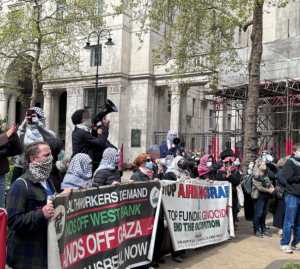
The Balfour conjuncture erupted irreversibly at the core of the UK Russell Group, in Edinburgh, a few weeks later, at the beginning of May 2025, when students joined the international student encampment movement spreading across continents, and set up tents at UoE’s Old College, home to the university administration. In their opening message on social media announcing the encampment, they declared: “Students take Lord Balfour University, known internationally as the University of Edinburgh.”Footnote91 They emphasized “the special legacy” of the University of Edinburgh “in the colonization of Palestine” and demanded that it “divest entirely from companies tied to Israel.”Footnote92 Our ongoing research, the community-led forms of truth-telling led by Abu Sitta and Saleh, and the archival materials we retrieved, helped inform both the student movement and the increasing involvement of staff in the anti-genocide and pro-divestment movement at UoE.
While “Balfour University Still Complicit with Genocide” became the official banner of the encampment, it was more than just a slogan. The connection and convergence between past and present—what we call Balfour’s afterlife—became a political conjuncture that took shape through the intersection of various processes and forces, giving the encampment a sense of historical mission. Multiple constituencies began to believe that the trajectory of historical injustice in which our institution has been implicated and that our research revealed in its granular aspects, could be challenged. This process led to the condensation and accumulation of multiple forces and community activism on campus, culminating in the largest mobilization for divestment since the 1970s.Footnote93
Balfour Must Fall Everywhere
This article has demonstrated, though only partially, the historical continuities of Balfour’s violent racial legacy and his imperial afterlife. In reading the breadth of his racial thinking, we showed how his declaration on Palestine was inscribed in his racialized imperial worldviews and quintessentially emblematic of them. We read this genealogy alongside an active movement at UoE calling for Palestinian liberation. Through various forms of political struggle at UoE, including a protracted hunger strike, students managed to mobilize over six hundred members of staff in support of divestment. This was achieved through a letter we drafted with colleagues, which was signed by the entire Decolonised Transformations network—meaning all the scholars engaged in reviewing our institution’s entanglements with colonialism and imperialism. As a network, we collectively signed the call for divestment, expressing full support for the student hunger strike and anti-genocide mobilization. We recognized that colonialism and imperialism are not merely historical legacies, but ongoing realities.
Our collective research on institutional entanglements with different forms and contexts of racial domination in the past became a tool for political struggle in the present. From the Palestine exception and the exclusion of Palestine from the race review, we reached a moment where Balfour and Palestine came to symbolize contemporary anti-colonial struggles. In this conjuncture, as scholars leading the Balfour section of the race review and as organizers of the Divestment Committee representing six hundred signatories, we engaged in the anti-genocide struggle by merging research, activism, and the pursuit of institutional change.
Figure 5. Student and staff mobilization for divestment and against Balfour University at UoE on June 17, 2024.
Source: Photo taken by Nicola Perugini.
Figure 6. Student and staff mobilization for divestment and against Balfour University at UoE. This was taken at Old College on May 29, 2024. Old College is where Balfour’s portrait once resided and has since been taken down. It is also where Abu Sitta and Saleh staged part of their interventions.
Source: Photo taken by Nicola Perugini.
Figure 7. Student and staff mobilization for divestment and against Balfour University at UoE. This was taken at Old College on May 19, 2024.
Source: Photo taken by Meher Vepari and used with permission.
UoE continues to resist divestment when it comes to Palestine. Despite issuing an official statement in response to the anti-genocide protests acknowledging its historical involvement in the dispossession of Palestinians through Balfour, the university remains unwilling to recognize that true reparations and justice can only come by ending the cycle of harm—particularly through financial profiteering from settler-colonial annihilation. Instead, the senior leadership team has deployed what one member of staff termed a “conflict agnostic” approach, refusing to engage with the Nakba and its settler-colonial afterlife. This Nakba denialism delimits the outcomes of the working groups that are informing court decisions on responsible investments and preventing precautionary divestment from companies involved with the Israeli military in Gaza. This approach also means that UoE runs the risk of eluding due diligence and exposing itself to complicity with genocide, crimes against humanity, and an illegal military occupation. Instead of financial disentanglement, the university prefers repetition of the colonial and imperial harms that the Balfour Declaration institutionalized more than a century ago.
In spite of our institution’s resistance to divestment, the collective process of understanding the relationship between past and present through Balfour’s violent legacy has triggered an irreversible political process. For the first time, a Western academic institution was forced, through anti-colonial political mobilization against Israel’s ongoing settler-colonial genocide, to transform Palestine from an exception to one of the core questions at the center of its investigations into the legacies of colonialism and imperialism in academic institutions. This is only the beginning of a much larger and urgently needed process. Our work at the intersection of research, anti-colonial mobilization, and reparatory justice is only a drop in the ocean compared with what remains to be done to delink Western academic institutions from their legacy of dispossession in Palestine. Indeed, this research and analysis of community engagement at UoE should serve as an invitation to colleagues and students in other institutions in the imperial center to look for and follow the traces of Palestinian dispossession in their archives, in their collections, in the names of their buildings, and in the names of their scholarships. Balfour must fall everywhere.
Acknowledgments
We wish to thank a number of people who worked with us and provided support toward this project: The UoE’s student-staff divestment movement and in particular the Gaza Solidarity Encampment. The former president of Edinburgh University Justice for Palestine Society and our research assistant Hajar Ibrahim, who helped us archive the mobilization for divestment, as well as Henry Dee and Tom Cunningham for their research assistance in the Centre for Research Collection (CRC). Our colleagues in CRC, Rachel Hosker and Daryl Green for their support in amassing relevant and helpful materials. Salman Abu Sitta for putting Balfour on trial in his centenary lecture on the British Mandate in Palestine, alongside Toufic Haddad for co-organizing this joint lecture. Farah Saleh for her lecture performance “Balfour’s Afterlife: Balfour Reparations 2025–2045” and the Institute for Advanced Studies in the Humanities for providing support around these various events. The Research and Engagement Work Group for their support toward the encampment and divestment movement, and toward our contribution with the reparations project. Nadim Bawalsa and R. R. Abdelnabi for their close and incisive editorial suggestions. This article was prepared with equal contribution by the authors.
Additional information
Funding
SRSF.
Notes on contributors
Nicola Perugini
Nicola Perugini is a senior lecturer in international relations at the University of Edinburgh.
Shaira Vadasaria
Shaira Vadasaria is a senior lecturer in sociology at the University of Edinburgh.
Notes
1 See Ruth Wilson Gilmore’s definition of racism as “state-sanctioned and/or extra-legal production and exploitation of group-differentiated vulnerabilities to premature death, in distinct yet densely interconnected political geographies.” Ruth Wilson Gilmore, “Race and Globalization,” in Geographies of Global Change: Remapping the World, ed. R. J. Johnston et al. (Blackwell Publishing, 2002), 261.
2 Full petition here: “Rename David Hume Tower at UoE,” Change.org, June 29, 2020, https://www.change.org/p/university-of-edinburgh-rename-david-hume-tower-at-uoe.
3 “The Chancellor,” University of Edinburgh, last accessed December 22, 2025, https://www.ed.ac.uk/about/people/officials/chancellor.
4 Noura Erakat, Justice for Some: Law and the Question of Palestine (Stanford University Press, 2019), 15–17.
5 Susan Pedersen, “Writing the Balfour Declaration into the Mandate for Palestine,” International History Review 45, no. 2 (2023): 279-91, https://doi.org/10.1080/07075332.2022.2123377.
6 Salman Abu Sitta, “A Palestinian Address to Balfour: In Honour of Truth, Memory, and Justice,” Palestine Land Society, November 8, 2022, https://www.plands.org/en/articles-speeches/speeches/2022/A-Palestinian-Address-to-Balfour.
7 We came together on this project having both joined UoE after teaching for several years at Al-Quds Bard College in Abu Dis—an experience that marked our lives and teaching by bringing us into Palestinian spaces of learning shaped by everyday resistance to settler-colonial occupation and dispossession. With Palestinian campuses under siege, students and staff strive to carry out their academic lives while resisting all forms of violence—restrictions on movement, invasive surveillance, arbitrary detention, torture, death, land and resource theft, and dispossession—we carried these memories with us and learned from them. With a deep sense of comradeship, solidarity, responsibility, and love for the communities we lived with during our years at Al-Quds Bard College, and with an unwavering commitment to the Palestinian struggle for liberation, we both joined UoE with a sense of loss and duty to maintain our bond to Palestine by engaging in new epistemic and political battles through which we do our small part. It was from these affective and political trajectories and commitments to Palestine’s liberation struggle that our research into Balfour’s deeds of destruction began.
8 “The Chancellor.” Alexander Campbell Fraser, “Professor Campbell Fraser’s speech on the occasion of the University of Edinburgh’s election of Balfour,” The Scotsman, Edinburgh University General Council, October 31, 1891, as cited in Tommy Curry et al., Decolonised Transformations: Confronting the University of Edinburgh’s History and Legacies of Enslavement and Colonialism (University of Edinburgh, June 2025), 45, https://www.ed.ac.uk/about/race-review/read-the-review.
9 Fraser, “Speech,” as cited in Curry et al., Decolonised Transformations, 48.
10 “The Chancellor.”
11 See Fraser’s speech in The Scotsman (1891). Balfour was succeeded by two other imperial chancellors who similarly spanned the worlds of academia and public affairs: John Buchan, Baron Tweedsmuir of Elsfield, was chancellor from 1937 to 1940, and was a well-known Scottish novelist, governor general of Canada (1935–40), an imperial administrator with Balfour in South Africa, and played a prominent intelligence role in the Middle East; and Victor Alexander John Hope, Marquess of Linlithgow, was chancellor from 1946 to 1952, and was both the general governor in India (1936–43) and a politician.
12 Lord Rayleigh (John William Strutt), Lord Balfour in His Relation to Science (Cambridge University Press, 1930); Sydney H. Zebel, Balfour: A Political Biography (Cambridge University Press, 1973); Ruddock F. MacKay, Balfour: Intellectual Statesman (Oxford University Press, 1985); Blanche Elizabeth Campbell Dugdale, Arthur James Balfour: First Earl of Balfour (Hutchinson, 1936).
13 Full project description here: Decolonised Transformations: Confronting the University’s Legacies of Slavery and Colonialism (blog), University of Edinburgh, https://blogs.ed.ac.uk/decolonise/.
14 As David Scott explains, the idea of reparatory history refers to a “dimension of moral history concerned specifically with historical wrongs that remain unrepaired in the present.” David Scott, Irreparable Evil: An Essay in Moral and Reparatory History (Columbia University Press, 2024), 27.
15 The concept of imperial afterlife draws inspiration from the work of Saidiya Hartman who coined the phrase “afterlife of slavery,” which is now a widely used analytic for understanding the ongoing material and psychic conditions of subjugation as instituted under the racial and economic structures of chattel slavery. This historiographical framework draws attention to the relentless and ongoing systems and structures of racial domination that define anti-Black violence, constitutive of Atlantic slavery, and instituted after formal abolition. Saidiya V. Hartman, Scenes of Subjection: Terror, Slavery, and Self-Making in Nineteenth-Century America (Oxford University Press, 1997). We pay homage to this concept and its legacy and draw on it as a way to also think about the afterlife of British empire and its lasting legacy in Palestine and on Palestinians, which many Palestinian scholars refer to as the “ongoing Nakba.” As Nasser Abourahme details in his recent work, Nakba, translated to catastrophe, first appears in the work of Constantin Zureiq, in his book, Ma´a al-Nakba, written amid the ethnic cleansing campaign in 1948. Nasser Abourahme, The Time Beneath the Concrete: Palestine Between Camp and Colony (Duke University Press, 2025). The concept of ongoing Nakba is also a historiographical frame that explains how the colonial dispossession of Palestine and Palestinians, and resistance to it, is part of Palestine’s ongoing liberation struggle against settler-colonial and imperial domination.
16 Primary sources include, but are not limited to, the University of Edinburgh’s institutional records (Court, Senatus Academicus, Accounts), student societies journals, and archival records on Arthur James Balfour, Edmund Allenby, and the Patrick Geddes collection. In person and remote research in archives beyond the University of Edinburgh records include the National Records of Scotland, National Library of Scotland, Library of Congress, and British Pathé. The research on contemporary university investments supporting settler-colonial dispossession and genocide in Palestine is based on: International Court of Justice and International Criminal Court records of investigations on events in Gaza after October 7, 2023; media; the United Nations; advocacy and human rights organizations; staff/student reports on companies that are complicit with human rights, international law, and Genocide Convention violations in the occupied Palestinian territories; the University of Edinburgh’s official institutional communications on the process of the reform of responsible investments; as well as the archives of the community mobilization preserved by different groups and divestment campaign participants.
17 Kerr Simeon, “Edinburgh Student Hunger Strikers Demand University Divests over Gaza ‘Complicity,’” Financial Times, May 16, 2024, https://www.ft.com/content/e5ddee87-be2b-4283-8a1f-ecddbd95c368.
18 Curry et al., Decolonial Transformations.
19 University of Edinburgh (UoE), “Statement from the Principal,” news release, January 19, 2021, https://www.ed.ac.uk/news/2021/addressing-contemporary-and-historic-racism/statement-from-principal.
20 UoE “Statement.”
21 “Member Bios: Researchers on the UoE and the Question of Palestine,” University of Edinburgh, last accessed December 10, 2025, https://blogs.ed.ac.uk/decolonise/2024/11/07/member-bios-researchers-on-the-uoe-and-the-question-of-palestine/.
22 Scott, Irreparable Evil, 58.
23 Scott, Irreparable Evil, 15.
24 Application of the Convention on the Prevention and Punishment of the Crime of Genocide in the Gaza Strip (South Africa v. Israel)–Intervention, I.C.J., January 24, 2024, https://www.icj-cij.org/case/192/intervention. Also, see Rosemary Sayigh, The Palestinians: From Peasants to Revolutionaries (Zed Books, 1979); Walid Khalidi, All That Remains: The Palestinian Villages Occupied and Depopulated by Israel in 1948 (Institute for Palestine Studies, 1992); Nur Masalha, Expulsion of the Palestinians: The Concept of “Transfer” in Zionist Political Thought, 1882–1948 (Institute for Palestine Studies, 1992); Ahmad H. Saʻdi and Lila Abu-Lughod, eds., Nakba: Palestine, 1948, and the Claims of Memory (Columbia University Press, 2007).
25 Jock Gallagher, Scotland’s Global Empire: A Chronicle of Great Scots (Whittles Publishing, 2014), 140–41. Also, see Zebel, Balfour.
26 Meeting minutes of the University Court Finance Committee, July 9, 1891, as cited in Curry et al., Decolonised Transformations, 48.
27 Fraser, “Speech,” as cited in Curry et al., Decolonise Transformation, 48.
28 Emigration: Secretary of State’s Correspondence, 1885, file AF51/1, National Records of Scotland, Edinburgh.
29 Jason Tomes, Balfour and Foreign Policy: The International Thought of a Conservative Statesman (Cambridge University Press, 2002), 78–81.
30 Tomes, Balfour and Foreign Policy, 2.
31 Arthur James Balfour, “A note on Indian reform,” August 7, 1917, cited in Tomes, Balfour and Foreign Policy, 65.
32 South Africa Bill of Lords, remarks by Arthur James Balfour, August 16, 1909, UK Parliament, House of Commons, Hansard, vol. 9, Column 1002, https://hansard.parliament.uk/commons/1909-08-16/debates/1a5e419c-77c8-4cbe-aa0e-e24099f46f50/SouthAfricaBillLords.
33 South Africa Bill of Lords, remarks by Arthur James Balfour, August 16, 1909.
34 L. S. Jacyna, “Science and Social Order in the Thought of A. J. Balfour,” Isis 71, no. 1 (March 1980): 31, https://doi.org/10.1086/352406.
35 Stefan Kühl, For the Betterment of the Race: The Rise and Fall of the International Movement for Eugenics and Racial Hygiene (Macmillan, 2013), 12–20.
36 Cited in Kühl, For the Betterment of the Race, 26; Jacyna, “Science and Social Order,” 31.
37 “Balfour Declaration, 2 November 1917: Promising Palestine Away,” Interactive Encyclopedia of the Palestine Question, last accessed December 9, 2025, https://www.palquest.org/en/highlight/157/balfour-declaration-2-november-1917.
38 Sherene Seikaly, Men of Capital: Scarcity and Economy in Mandate Palestine (Stanford University Press, 2016), 5–6.
39 Pedersen, “Writing the Balfour Declaration.” Also, see Sahar Huneidi, “Was Balfour Policy Reversible? The Colonial Office and Palestine, 1921–23,” JPS 27, no. 2 (1998): 33, https://doi.org/10.2307/2538282.
40 Ilan Pappe, The Ethnic Cleansing of Palestine (One World, 2007); Sa’di and Abu-Lughod, Nakba; Nahla Abdo and Nur Masalha, eds., An Oral History of the Palestinian Nakba (Bloomsbury Publishing, 2019).
41 As historians Rashid Khalidi and Sherene Seikaly argue, “To begin the story in 1917 is to name the struggle for what it is: settler colonialism. We know that Zionism was a response to centuries of Judeophobia in Europe and, more immediately, the consolidation of state-led anti-Semitism in the late nineteenth and early twentieth centuries. However, Zionism was not the most popular response to the oppression of Jewish people in Europe, nor was it the only one.” Rashid I. Khalidi and Sherene Seikaly, “From the Editors,” JPS 50, no. 3 (2021): 2, https://doi.org/10.1080/0377919X.2021.1947645.
42 Shawan Jabarin and Ralph Wilde, “How Britain Broke International Law to Stop Palestinian Independence 100 Years Ago,” Mondoweiss, September 29, 2023, https://mondoweiss.net/2023/09/how-britain-broke-international-law-to-stop-palestinian-independence-100-years-ago/. Also, see John Quigley, “Britain and the League of Nations: Was There Ever a Mandate for Palestine?,” JPS 53, no. 2 (2024): 35–49, https://doi.org/10.1080/0377919X.2024.2366771.
43 United Nations, The International Status of the Palestinian People, 1981, https://www.un.org/unispal/document/auto-insert-204352/. Also, see Michael Adams, “What Went Wrong in Palestine?,” JPS 18, no. 1 (1988): 71–82, https://doi.org/10.2307/2537595. For the original source, see Letter from Mr. Balfour to Lord Curzon, Foreign & Commonwealth Office’s Public Records Office, August 11, 1919, file FO.371/4183, National Archives, United Kingdom.
44 Pappe, Ethnic Cleansing of Palestine, 52–54.
45 Rashid Khalidi, The Hundred Years’ War on Palestine: A History of Settler Colonialism and Resistance, 1917–2017 (Metropolitan Books, 2020), 17–54.
46 David Englander, ed., A Documentary History of Jewish Immigrants in Britain, 1840–1920 (Leicester University Press, 1994), 10.
47 Aliens Bill, Remarks by Arthur James Balfour, July 10, 1905, UK Parliament, Hansards, vol. 149, column 155, https://api.parliament.uk/historic-hansard/commons/1905/jul/10/aliens-bill.
48 Decolonised Transformations Project, internal correspondence, February 5, 2025.
49 Arthur James Balfour, Speeches on Zionism (Arrowsmith, 1928), 25.
50 Tomes, Balfour and Foreign Policy, 212.
51 Edward Said, The Question of Palestine (Vintage Books, 1979), 16.
52 Tamson Pietsch, Empire of Scholars: Universities, Networks and the British Academic World, 1850–1939 (Manchester University Press, 2013). On Balfour as a white supremacist, see Yousef Munayyer, “It’s Time to Admit That Arthur Balfour Was a White Supremacist—and an Anti-Semite Too,” Institute for Palestine Studies, November 1, 2017, https://www.palestine-studies.org/en/node/232119.
53 Official Report of the Allied Colonial Universities, in The Empire Review, VI (London, 1904), p. 121, Special Collections, Main Library, University of Edinburgh.
54 Official Report of the Allied Colonial Universities, p. 121.
55 Official Report of the Allied Colonial Universities, p. 122.
56 Report of Proceedings: Congress of the Universities of the Empire (University of London Press and Hodder & Stoughton, 1912), 25.
57 Arthur Balfour, Decadence (Cambridge University Press, 1908), 35.
58 Balfour, Decadence, 46–47.
59 Chaim Weizmann, Trial and Error: The Autobiography (Hamish Hamilton, 1949), 390.
60 Weizmann, Trial and Error, 391.
61 The University of Edinburgh’s Centre for Research Collections holds the largest existing archival collection on Geddes. Moreover, the university has a Patrick Geddes Hall, which includes a dedicated Geddes plaque at the entrance. “Sir Patrick Geddes,” University of Edinburgh, November 12, 2024, https://www.ed.ac.uk/about/people/plaques/geddes.
62 Nazmi Jubeh, “Patrick Geddes: Luminary or Prophet of Demonic Planning,” Jerusalem Quarterly, no. 80 (Winter 2019): 26 and 38, https://www.palestine-studies.org/en/node/1649528.
63 Hebrew University and Lord Balfour’s visit. Lord Balfour declaring university open, file LC-M32- B-434 [P&P], April 1, 1925, G. Eric and Edith Matson Photograph Collection, Library of Congress, https://www.loc.gov/item/2019697069/.
64 “Hebrew University. Distinguished Visitors to Jerusalem,” The Scotsman, March 18, 1925, 10, as cited in Curry et al., Decolonised Transformation, 53. The Balfour-Einstein Institute of Mathematics and Physics was the initial name given to this institute, which can also be found in the American Jewish Yearbook of 1926 and 1927, vol. 28.
65 Roy Macleod, “Balfour’s Mission to Palestine: Science, Strategy, and the Inauguration of the Hebrew University in Jerusalem,” Minerva 46 (2008): 75, https://doi.org/10.1007/s11024-008-9087-x. Balfour, Speeches on Zionism, 78 and 83.
66 The Yearbook of the Universities of the Empire (Bell and Sons, 1925), 497.
67 The Yearbook of the Universities of the Empire (Bell and Sons, 1930), 528. Moïse Berenstein, “Jewish Colonisation in Palestine; II,” International Labour Review 30, no. 6 (1934): 797–819, https://researchrepository.ilo.org/esploro/outputs/journalArticle/Jewish-colonisation-in-Palestine-II/995219341902676?institution=41ILO_INST. For a history of the JNF and its role in Palestinian dispossession, see Walter Lehn, “The Jewish National Fund,” JPS 3, no. 4 (1974): 74–96, https://doi.org/10.2307/2535450.
68 Balfour, Speeches on Zionism, 110 and 112.
69 “Balfour at Jewish colonies,” Matson Collection negative numbers 13816-13914, file LC-M32- 13876 [P&P], 1925, G. Eric and Edith Matson Photograph Collection, Library of Congress, https://www.loc.gov/item/2019695045/.
70 Senate minutes, University of Edinburgh, July 20, 1926, files 360 and 361, Centre for Research Collections, University of Edinburgh.
71 Senate minutes, University of Edinburgh, July 20, 1926.
72 “Rectors Past and Present,” University of Glasgow, last accessed December 9, 2025, https://www.gla.ac.uk/alumni/ouralumni/rectorspastandpresent/.
73 “The Chancellor.”
74 Robert John Strutt Rayleigh (Lord Rayleigh), Lord Balfour in His Relation to Science (Cambridge University Press, 1930).
75 Shaira Vadasaria and Nicola Perugini, “Arthur James Balfour: The University of Edinburgh’s Imperial Chancellor (1891–1930),” Retrospect Journal, no. 29 (June 2021): 24–27, https://retrospectjournal.com/race-in-retrospective-2/.
76 Katy Prickett, “Police End Balfour Portrait Damage Investigation,” BBC, March 13, 2025, https://www.bbc.com/news/articles/cx2xpnx93epo.
77 Salman Abu Sitta, “A Palestinian Address to Balfour: In Honor of Truth, Memory, and Justice,” Mondoweiss, November 30, 2022, https://mondoweiss.net/2022/11/a-palestinian-address-to-balfour-in-honor-of-truth-memory-and-justice/.
78 Abu Sitta, “A Palestinian Address to Balfour.”
79 Stuart Hall, The Hard Road to Renewal: Thatcherism and the Crisis of the Left (Verso, 1988), 130.
80 Hall, Hard Road to Renewal, 43.
81 Francesca Albanese, From Economy of Occupation to Economy of Genocide: Report of the Special Rapporteur on the Situation of Human Rights in the Palestinian Territories Occupied Since 1967, A/HRC/59/23, June 30, 2025, p. 25, https://docs.un.org/en/A/HRC/59/23.
82 “A University of Sanctuary: Israel and Palestine,” University of Edinburgh, December 4, 2023, https://university-of-sanctuary.ed.ac.uk/israel-and-palestine.
83 “Balfour Reparations (2025–2045),” FarahSaleh.com, last accessed December 9, 2025, https://www.farahsaleh.com/balfour-reparations.
84 “Fact Check: University of Edinburgh’s Apology Letter to Palestinians Is Fictional,” Reuters, December 21, 2023, https://www.reuters.com/fact-check/university-edinburghs-apology-letter-palestinians-is-fictional-2023-12-21/.
85 Application of the Convention on the Prevention and Punishment of the Crime of Genocide in the Gaza Strip (South Africa v. Israel).
86 Agenda and papers of the Senatus Academicus, University of Edinburgh, May 22, 2024, https://registryservices.ed.ac.uk/sites/default/files/2024-07/22%20May%202024%20-%20Agenda%20and%20papers.pdf.
87 “Former Chancellors,” University of Edinburgh, last accessed December 12, 2025, https://www.cam.ac.uk/about-the-university/how-the-university-and-colleges-work/people/chancellor/former-chancellors.
88 Prickett, “Police End Balfour.” Official statement by Palestine Action. Link removed from the internet after Palestine Action was declared a terrorist organization by the UK government.
89 Nicholas Mirzoeff, To See in the Dark: Palestine and Visual Activism Since October 7 (Pluto Press, 2025), 102–3.
90 Imran Mulla, “Cambridge’s Wealthiest College Votes to Divest from Arms Companies,” Middle East Eye, May 12, 2024, https://www.middleeasteye.net/news/cambridges-wealthiest-college-divest-arms-companies.
91 Edinburgh University Justice for Palestine Society (eu_jps), “Gaza Solidarity Camp at the University of Edinburgh,” Instagram, May 5, 2024, https://www.instagram.com/p/C6lcH7VoFxX/?img_index=3&igsh=ang3cWVucm95OHkx.
92 Edinburgh University Justice for Palestine Society (eu_jps), “Gaza Solidarity Camp at the University of Edinburgh.”
93 The last comparable campaign on campus addressing the university’s complicity with a settler-colonial apartheid regime was the one that ultimately resulted in full divestment from South Africa in 1971.