

2 March 2026
As reported last week, Forensic Architecture and Earshot, two groups of London-based forensic analysts, have undertaken a careful study of the killing of 15 humanitarian workers in southern last March. Here is the link to their lengthy report:
And here is the Introduction and Summary of their research:
- INTRODUCTION AND CONTEXT
- On 18 March 2025, airstrikes by the Israeli military broke the ‘ceasefire’ agreement of 17
January 2025 in Gaza, killing at least 414 Palestinians, including 174 children .1 This renewed air
assault continued throughout the following days.
On Sunday 23 March 2025, at 3:52, two Palestinian Red Crescent Society (PRCS) 2
ambulances were dispatched to the scene of an airstrike in al-Hashahin, near Rafah in the south
of Gaza. 3 The first ambulance departed from the PRCS headquarters in Khirbet al-Adas, east
of Rafah, with crew members Saleh Muammar, Raed al-Sharif and Ashraf Abu Libda
(Ambulance A). The second departed from the British Field Hospital, west of Rafah, with crew
members Mustafa Khafaja, Ezz El-Din Shaat and Munther Abed (Ambulance B). - At 3:55, Ambulance B lost contact with PRCS headquarters while driving south towards Tel al
- Sultan, with its internal and external emergency lights on, and all crew members wearing
- official uniforms or volunteer vests . It was later discovered that, Ambulance B had come under
- direct fire near Tel al-Sultan, in an area hereafter referred to as the ‘incident site ’, defined in
- our investigation as a stretch along Gush Katif Road, with a radius of approximately 200m departing from the site where Ambulance B was attacked and its journey
- aborted (Figure 1). As a result of the attack, crew members Mustafa and Ezz El-Din were killed.
- While the fate of Ambulance B was still unknown, having completed its rescue mission at al
- Hashashin, Ambulance A was dispatched towards the British Field Hospital to search for
- Ambulance B. Ambulance A was joined by two more PRCS vehicles: Ambulance C, with crew
- members Muhamad Bahloul and Muhamad al-Hila, and Ambulance D, with Asaad al-Nasasra
- and Refaat Radwan. Th is ‘rescue convoy ’ located the missing Ambulance B at 4:39. The crew
- of Ambulance A used their radio to call for support, and two vehicles belonging to the
- Palestinian Civil Defence (PCD), 4 an ambulance and a fire truck, subsequently joined the
- convoy. All vehicles were clearly marked and had their emergency lights on. This convoy was
- also attacked upon its arrival to the scene shortly after 5:00.
- Between the time of the attack on the convoy and 6:05, two UN vehicles, a Toyota Hilux and a
- minibus, had also passed by the incident site and been similarly attacked.
- In total, fifteen Palestinian aid workers were killed by Israeli forces at the incident site on 23
- March 2025. According to report s, some of the victims had been, shot ‘execution-style’ from
- close range.
- The victims were:
- Mustafa Khafaja , ambulance officer ,PRCS
- Ezz El-Din Shaat , ambulance officer, PRCS
- Saleh Muammar , ambulance officer , PRCS
- Refaat Radwan , first responder volunteer, PRCS
- Muhammad Bahloul , first responder volunteer, PRCS
- Ashraf Abu Libda , first responder volunteer, PRCS
- Muhammad al-Hila, first responder volunteer, PRCS
- Raed al-Sharif, first responder volunteer, PRCS
- Zuhair Abdul Hamid al-Farra, fire truck driver, PCD
- Samir Yahya al-Bahapsa , firefighter officer, PCD
- Ibrahim Nabil al-Maghari , firefighter officer, PCD
- Fouad Ibrahim al-Jamal , ambulance driver, PCD
- Youssef Rassem Khalifa , ambulance officer , PCD
- Anwar al-Attar, ambulance officer , PCD
- Kamal Mohammed Shahtout , UNRWA
Following the ambush, Israeli forces crushed all eight vehicles using heavy machinery, and
attempted to bury them under the sand.
The body of Anwar al-Attar was found near the incident site on 27 March, 6 and the bodies of
the other fourteen victims, all wearing identifying uniforms or volunteer vests of their respective
organisations, were found in a mass grave near the site on 30 March.
On 28 March, after the discovery of al-Attar’s body, the Israeli military admitted that its soldiers
had fired on ‘ambulances and fire trucks’ (NB: our investigation indicated that there was only
one fire truck present) after identifying them as ‘suspicious vehicles’. 7 On 31 March, after the
remaining bodies were discovered near the site, Israeli military spokesperson Nadav Shoshani
claimed in a post on X that ‘several uncoordinated vehicles were identified advancing
suspiciously toward IDF troops without headlights or emergency signals ’.8
On 2 April, Munther, one of the two PRCS crew members who had survived the attack, gave
an interview to the BBC in which he reported that all of the vehicles in question had had their
emergency lights on when they came under fire .9
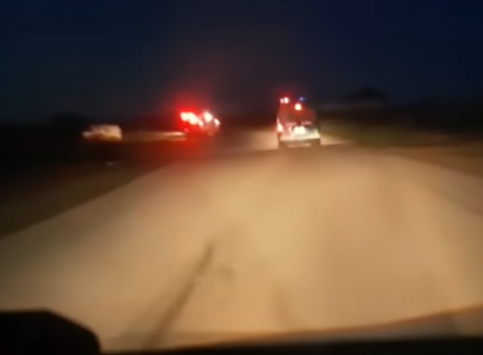
Two days later on 4 April, the PRCS president reported in a press briefing that a video of the
incident had been recovered from the cell phone of one of the murdered paramedics , and that
he had presented it to the UN Security Council to increase pressure for an independent and
thorough investigation .10 The recording , which was published the same day by the New York
Times (and the day following by the PRCS on their X account) , showed that the vehicles in the
convoy were clearly marked as emergency vehicles with their emergency lights on when they
were fired upon without warning .11 It also showed that a number of the victims had been
wearing reflective high visibility uniforms at that time.
On 5 April, multiple media outlets reported on a briefing earlier that day at which a
spokesperson for the Israeli military admitted that their earlier statement claiming that the
emergency vehicles had approached with their lights off was inaccurate . Instead, the Israeli
official claimed that soldiers had initially fired on a vehicle contain ing three Hamas members,
and that the convoy of responding ambulances was perceived as a threat because it had
stopped alongside said vehicle .12
Asaad, the other PRCS crew member who survived the incident, was abducted by the Israeli
military immediately following the attack . His whereabouts had remained unknown to the
PRCS until 14 April, when they were informed that Asaad was being held captive by the Israeli
military.13 He was released fifteen days later on 29 April 2025 in poor health after having been
detained without charge for 37 days. 14
On 20 April, the Israeli military announced that an internal inquiry into the incident had
‘identified several professional failures’ and ‘breaches of orders’.15 Its report denied that there
had been ‘indiscriminate fire’ by soldiers, blamed the attacks on ‘poor night visibility’ and
maintained that the incident had unfolded in a ‘hostile and dangerous combat zone, under a
widespread threat to the operating troops’ .
Three days later, the Israeli version of Haaretz published an article claiming that the Israeli
military’s published report excluded key findings from its inquiry into the incident, among them
that: on one occasion Israeli forces had indiscriminately fired at the aid convoy ; the road along
which the vehicles were attacked was designated safe for passage by rescue workers and
civilians under the military’s own regulations ; the unit that had carried out the attack had
explicitly been informed beforehand of increased ambulance traffic in the area; a
reconstruction of the scene conducted with the commanding officer of the unit responsible for
the attack revealed they would have clearly been able to see the flashing lights of the
emergency vehicles from their position ; and that one of the soldiers questioned an Arabic
speaking detainee about the identity of his colleagues and conclud ed, despite not speaking
Arabic, that they were Hamas operatives. 16
The claims and allegations of the Israeli report continue to be collectively rejected by PRCS,
the United Nations Relief and Works Agency for Palestine Refugees in the Near East
(UNRWA) , and the PCD service.
SUMMARY OF FINDINGS
Earshot and FA’s investigation offers detailed evidence regarding the circumstances of the
incident on 23 March 2025 in Tel al-Sultan, including extrajudicial executions, a survivor being
forced to work at an Israeli military checkpoint , and efforts to conceal, disturb, and erase
evidence relating to the attack.
Our investigation demonstrates the following:
3.1. Israeli soldiers ambushed and subjected Palestinian aid workers to continuous assault by
gunfire for over two hours, between 5:09 and 7:13. There was no exchange of fire in the
area, and no tangible threat to the safety of those soldiers. These attacks did not happen
in ‘a hostile and dangerous combat zone’, as was claimed by Israeli spokespersons.
3.2. At least 910 gunshots were documented across the three recordings from the night . The
majority of these gunshots , at least 844, were captured in Refaat Radwan’s video , all fired
within a five-and-a-half-minute period.
3.3. At least 93% of the gunshots fired by the Israeli soldiers were fired directly towards the
emergency vehicles and aid workers during the first five-and-a-half minutes of the attack .
During this time, at least five shooters fired simultaneously , and witness testimonies
suggest as many as thirty soldiers were present in the area .
3.4. Israeli soldiers were positioned on high ground by the road on which the victims’ vehicles
travelled, with no obstructions limiting the line of sight of the soldiers. The emergency
lights and markings of the victims’ vehicles would have been clearly visibl e to the soldiers
at the time of the attacks.
3.5. The soldiers advanced on the aid workers and the ambulances while shooting. Upon
reaching them, they moved through the vehicles and shot several of the aid workers at
close range.
3.6. At least 8 gunshots were fired from positions in-between the emergency vehicles. One
of these gunshots was fired from within one to four metres of Ashraf Abu Libda ’s position.
The timing of those shots coincided with the last time his voice was heard in recordings
from the night, strongly suggesting that these were the shots that killed him.
3.7. One of two PRCS survivors of the attack was later used as a ‘human tool’ at an Israeli
military checkpoint near to the incident site.
3.8. Israeli military personnel acted intentionally to conceal and disrupt evidence of the attack
by:
3.8.1. Burying the bodies of the victims;
3.8.2. Burying the mobile phones of at least one of the victims;
3.8.3. Crushing and partially burying the victims’ vehicles;
3.8.4. Transforming the site with earth-moving vehicles in the hours immediately
following the attack;
3.8.5. Detaining one of the witnesses to the attack (see 3.12).
3.9.
The intentional concealment and disruption of evidence involved, among others, soldiers
named Elias, Yotam, and Amatzia.
3.10.
The earthworks carried out at the site in the hours after the attack transformed the
incident site into an evacuation route. Two checkpoints were established near to the
incident site, and a series of earth berms were built and later used for holding and
interrogating Palestinians passing through the checkpoint.
3.11.
Between 23 March and 30 May 2025, the area surrounding the incident site was further
transformed by the Israeli military’s construction of the ‘Morag’ corridor and
erection of an aid distribution site operated by the Gaza Humanitarian Foundation (GHF).
3.12.
In the 37 days following the attack, one of the two survivors of the attack was detained
without charge, tortured, and interrogated in relation to the incident detention camp.